
01Start With Weft Insertion, Not a Quality Ranking
Woven webbing is built from lengthwise warp yarns and crosswise weft yarns. The warp is separated into a shed, the weft is inserted, and the reed places each pick against the growing fabric. A buyer comparing needle-loom and shuttle-loom webbing is therefore asking how the weft crosses the shed and how it is secured at the sides—not whether one machine name automatically guarantees a better strap.
Jakob Müller’s official narrow-fabric weaving training contents treat shuttle and needle methods as two distinct weft-insertion systems. Its current NF narrow-fabric loom information also shows that a needle-loom platform can be configured with features such as leno selvedge motion, different shedding arrangements, warp control and fabric take-off. This matters because “needle loom” describes a family of production routes, not one fixed edge, weave, density or product result.
A shuttle transports a weft supply through the shed so the weft can continue from one pick to the next at the sides. In shuttleless narrow weaving, a needle carries a loop of weft into the shed and the loop is secured at the receiving edge by a catch, binder or knitting element. The exact yarn path and edge treatment depend on the machine setup and article design. Buyers should ask for a construction description or edge diagram rather than relying on a one-word label.
02Read Both Edges, the Face and the Reverse
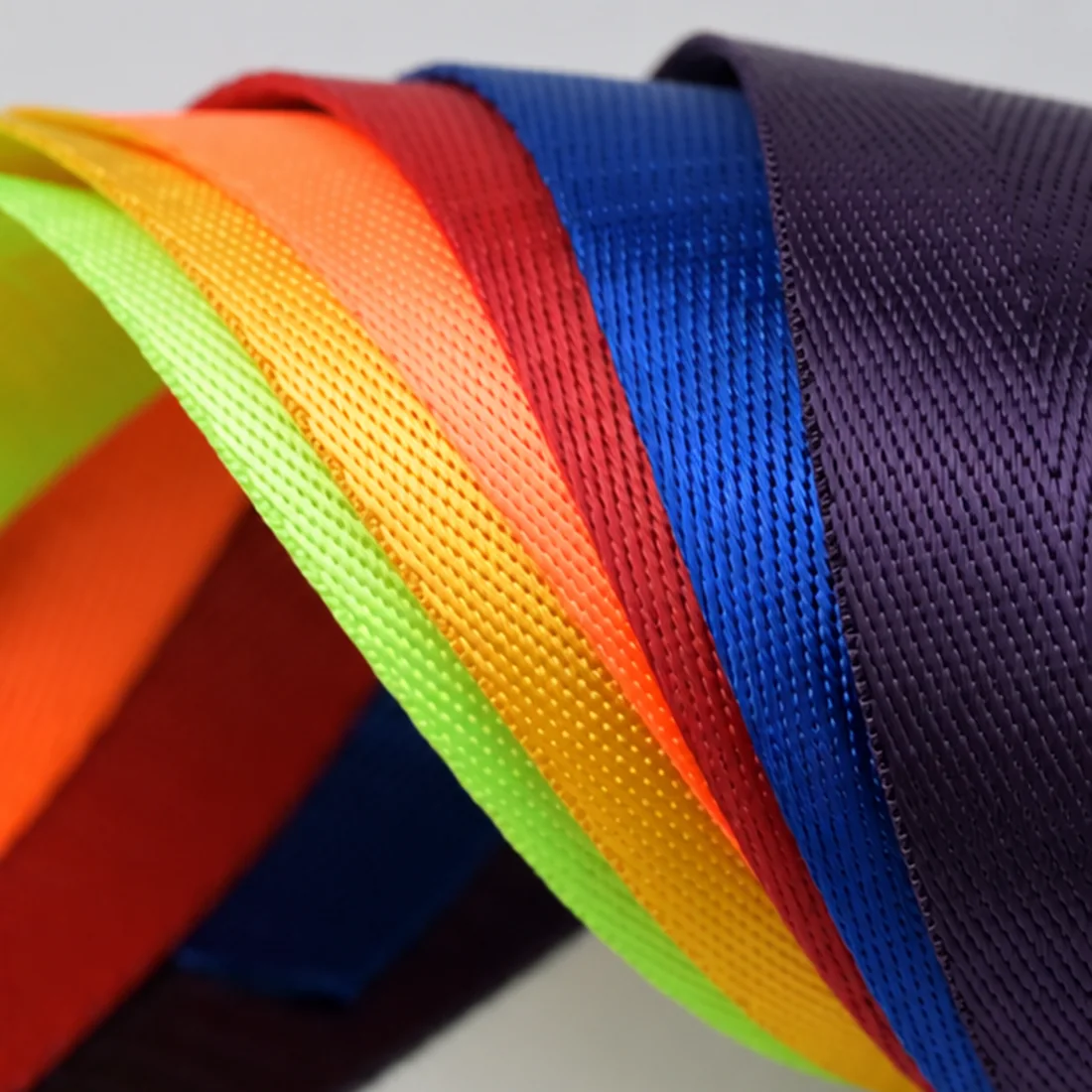
The most useful first comparison is a physical sample long enough to show both edges, face and reverse in a relaxed state. A shuttle-woven sample may present two similarly formed woven edges because the weft turns at both sides. A needle-woven sample often has a distinguishable insertion side and a retained-loop side. However, extra binding yarns, leno elements, finishing and dense constructions can make the difference subtle. A photograph of one face is not enough to classify the product reliably.
Document what the buyer can actually approve: edge width and profile, visible catch or binder yarn, face-to-reverse difference, waviness, exposed loops, loose ends, colour contrast and any edge thickening. If the edge will remain visible on a fashion product, include the viewing distance and orientation. If it will run through a buckle or adjuster, record which edge contacts the hardware and whether the webbing twists or tracks to one side.
Do not infer performance from neatness alone. A visually symmetrical edge may still be unsuitable for a particular buckle, seam or repeated bend. A visibly knitted or bound edge may perform well in its intended assembly. Appearance inspection answers an appearance question; construction identification and application testing answer different questions.
| Sample feature | What to record | Why it matters |
|---|---|---|
| Left and right edges | Profile, loops, binder or catch yarn, colour and visible damage | Edges may contact hardware, remain visible or enter a seam differently |
| Face and reverse | Texture, float pattern, logo or stripe clarity and side-to-side symmetry | The assembly may expose both sides or require a defined face |
| Cross-section | Flat, layered or tubular form; relative edge and centre thickness | Thickness distribution affects folds, slots and sewing |
| Relaxed length | Waviness, twist, bow or tendency to curl | Distortion can complicate cutting, alignment and assembly |
Record observations before assigning causes. A visible edge feature does not by itself prove a loom type, fibre or performance level.
03Use Governing Specifications Without Generalising Them
Some controlled applications define loom route explicitly. The U.S. Defense Logistics Agency’s MIL-DTL-4088L, for woven nylon webbing, classifies Class 1 as shuttle-loom nylon 6,6, Class 1A as shuttleless-loom nylon 6,6, and Class 2 as shuttle or shuttleless nylon 6 or 6,6. That is strong evidence that both routes can be engineered within a formal product specification. It is not evidence that those classes apply to a handbag strap, apparel trim or another commercial webbing.
When a drawing, customer standard, regulated programme or adopted specification identifies a class, edition, type or construction, copy the exact reference into the RFQ and purchase order. Confirm whether amendments, drawings, colour standards, sampling rules or first-article requirements also apply. A supplier’s statement that a webbing is “military grade,” “shuttle quality” or “needle loom quality” does not establish conformity without the named document, applicable type and required evidence.
For commercial development without a governing loom requirement, start from the finished product. The decision may be driven by a desired woven edge, a tubular construction, pattern possibilities, available yarn system, hardware passage, fold thickness, visual symmetry, order economics or an established approved sample. Ask suppliers to propose a route, but make the approval decision against the output and application rather than the sales description.
04Specify the Finished Output the Loom Must Produce
A reproducible brief separates nominal values from measurement conditions. Define finished width and whether the edges are included. ASTM D3774-18(2024) covers width measurement for woven and knitted fabrics, with options for a full roll or short specimen. Buyers should confirm suitability for their narrow fabric and state the relaxed or applied-tension condition, measurement positions, number of readings and acceptance rule. A width stated without condition can produce disagreement when a tape is pulled from a roll under tension.
Thickness needs the same discipline. ASTM D1777-26 explains that apparent textile thickness changes with the pressure applied, making the stated pressure essential. For webbing that must pass through a slot or fold into a seam, measure the relevant locations and layers under an agreed method. A single centre reading may not represent a thicker bound edge or a folded assembly.
Add construction and appearance fields that remain useful even if the supplier changes equipment: declared fibre and yarn form, weave or drawing reference, warp and weft colour, pattern repeat, face and reverse, edge construction, hand or flexibility reference, finish, roll format, splice rules and cut-end treatment. Mark which items are fixed, toleranced, sample-controlled or open for supplier proposal. Require written notice before a change to the loom route, yarn system, binder or catch yarn, edge configuration or finish.
- Finished width, measurement condition and tolerance agreed by both parties.
- Thickness method, pressure and measurement locations stated where hardware or seams depend on it.
- Both edges, face and reverse shown in the approved sample record.
- Construction or weave reference linked to a revision, not described only as “standard webbing.”
- Colour, hand, finish, roll or cut format and acceptable joins defined separately.
05Validate Hardware, Seams and Folds on the Real Assembly
Loom selection cannot be separated from the assembly. A bag strap may pass repeatedly through an adjuster, fold around a ring, carry bartack stitches and expose one edge to the user. An apparel trim may be folded, topstitched and washed. A decorative tape may show both sides around a loop. Map each contact, bend, cut and visible zone, then test the proposed sample in the same orientation and layer count.
For hardware, review slot clearance, insertion force, adjustment force, holding or slip behaviour, edge rubbing and tracking. Do not assume that equal nominal width means equal fit: edge profile, thickness, surface texture and compressibility all contribute. For sewn areas, check needle and thread selection, stitch placement, edge distance, folding, puckering, yarn damage and the appearance of the reverse. The complete joint carries the load, not the loose webbing alone.
Use a side-by-side prototype when a loom-route change is proposed. Keep material, width, colour and hardware as constant as practical, then compare only the decisions that matter. If several variables change together, record them rather than attributing every difference to the loom. A successful sample is evidence for the tested configuration and assembly, not for every product made by that machine family.
| Application question | Prototype check | Approval evidence |
|---|---|---|
| Will an edge rub on hardware? | Cycle the real routing under representative tension and inspect both edges | Defined visual limit plus any relevant retained-performance criterion |
| Will the webbing fold or stack? | Build the actual layer count and seam | Thickness, stitch quality, shape and appearance after assembly |
| Will both sides be visible? | Review face, reverse, edge transitions and joins | Labelled sample with approved orientation and viewing conditions |
| Is a tubular form required? | Confirm the construction and build the intended insert or loop | Section, dimensions and completed-component approval |
Prototype conditions should reflect the real product. A loose-tape comparison cannot validate every hardware, seam or wear interaction.
06Plan Edge and Abrasion Checks Around the Actual Risk
Edge durability is often the reason buyers ask about shuttle versus needle weaving, but “abrasion resistant” is incomplete without an abradant, contact geometry, tension, pressure, cycle definition, conditioning and decision rule. A hardware slot creates a different action from a rough garment panel, a conveyor surface or repeated hand adjustment. Start with the actual contact, then select a component or assembly test that reproduces the important mechanism closely enough to support the decision.
ASTM D6770-24 measures webbing abrasion with a hex-bar apparatus and expresses the result through retained breaking force. Its official significance statement also warns that abrasion is affected by fibre, yarn, construction, treatment, abradant, tension, pressure and dimensional change, and that laboratory results should not predict service life without evidence connecting the test to the end use. This is precisely why a machine label cannot substitute for a test plan.
Before comparing results, identify the specimen, lot, edge orientation, conditioning, method edition, equipment and acceptance rule. Inspect the failure mode as well as the final number: edge-loop damage, catch-yarn breakage, surface fuzzing, yarn displacement, width change and hardware tracking may lead to different design responses. If the buyer and supplier use different methods or fixtures, align them before treating the numbers as comparable.
07Needle-Loom and Shuttle-Loom Webbing RFQ Checklist
Ask about the loom only after the application and finished requirements are clear. A useful supplier response should identify the proposed weaving route, explain the edge construction in plain language and return a sample that carries the same item code and revision as the quotation. When the supplier recommends a different route, request the reason and the verification plan rather than assuming the change is automatically an upgrade or downgrade.
Keep the approved construction under change control. A repeat order should cite the current sample and specification, and the supplier should disclose planned changes that can affect edge, appearance, dimensions, hand or application performance. This turns the loom discussion into a practical development decision that purchasing, design, quality and production teams can all review.
- State the finished product, webbing location, load path and visible sides.
- Name any governing specification, class, type, edition and related drawing.
- Define width, thickness, material direction, weave, colour, finish and hand.
- Describe both edge profiles and whether a catch, binder or contrasting yarn may be visible.
- Provide hardware, seam, fold, cut and care conditions for sample validation.
- Agree appearance, dimensional and application-performance acceptance rules.
- Approve a labelled sample with face, orientation, item code and revision identified.
- Require advance notice for loom-route or edge-construction changes.
08Frequently Asked Questions
Is shuttle-loom webbing always stronger than needle-loom webbing?
No. Strength depends on the complete material and construction, including fibre, yarn, weave, density, dimensions, finish, edge system and test method. A governing specification may require a loom class for a defined product, but that requirement should not be generalised to unrelated webbing.
How can I identify needle-loom webbing from a sample?
Inspect both edges, face and reverse for a retained weft loop, catch or binder yarn and an insertion-side difference. Dense, finished or specially bound constructions can hide these features, so confirm the yarn path with the supplier or a construction diagram instead of classifying from one photograph.
Does needle-loom webbing have only one usable edge?
Not necessarily. Needle-loom systems can use different binding and selvedge configurations, and suitability depends on the article design and application. Specify the required appearance and behaviour of both edges, then approve the actual sample in its hardware or seam.
When should an RFQ require a specific loom type?
Require it when a governing customer, product or procurement specification names the loom route or class, or when a validated construction feature cannot otherwise be controlled. For ordinary commercial development, output requirements plus an approved construction sample are usually more informative than a machine label alone.
What should be reapproved if the supplier changes from shuttle to needle weaving?
Treat it as a controlled construction change. Compare both edges, face and reverse, dimensions, thickness distribution, hand, hardware fit, sewing or folding, appearance and the performance checks linked to the real use. Issue a new revision and master sample if the change is accepted.
09Continue From Guide to Specification
Compare the relevant product family and application page before sending your RFQ.
10Sources & further reading
Sources support the principles discussed; the final specification and test plan must follow the application and buyer requirements.
- Narrow Fabric Weaving — Contents and Weft Insertion MethodsJakob Müller Institute of Narrow Fabrics
- NF Narrow Fabric Weaving SystemsJakob Müller AG
- MIL-DTL-4088L — Webbing, Textile, Woven NylonU.S. Defense Logistics Agency ASSIST Quick Search
- ASTM D3774-18(2024) — Standard Test Method for Width of Textile FabricASTM International
- ASTM D1777-26 — Standard Test Method for Thickness of Textile MaterialsASTM International
- ASTM D6770-24 — Standard Test Method for Abrasion Resistance of Textile WebbingASTM International