
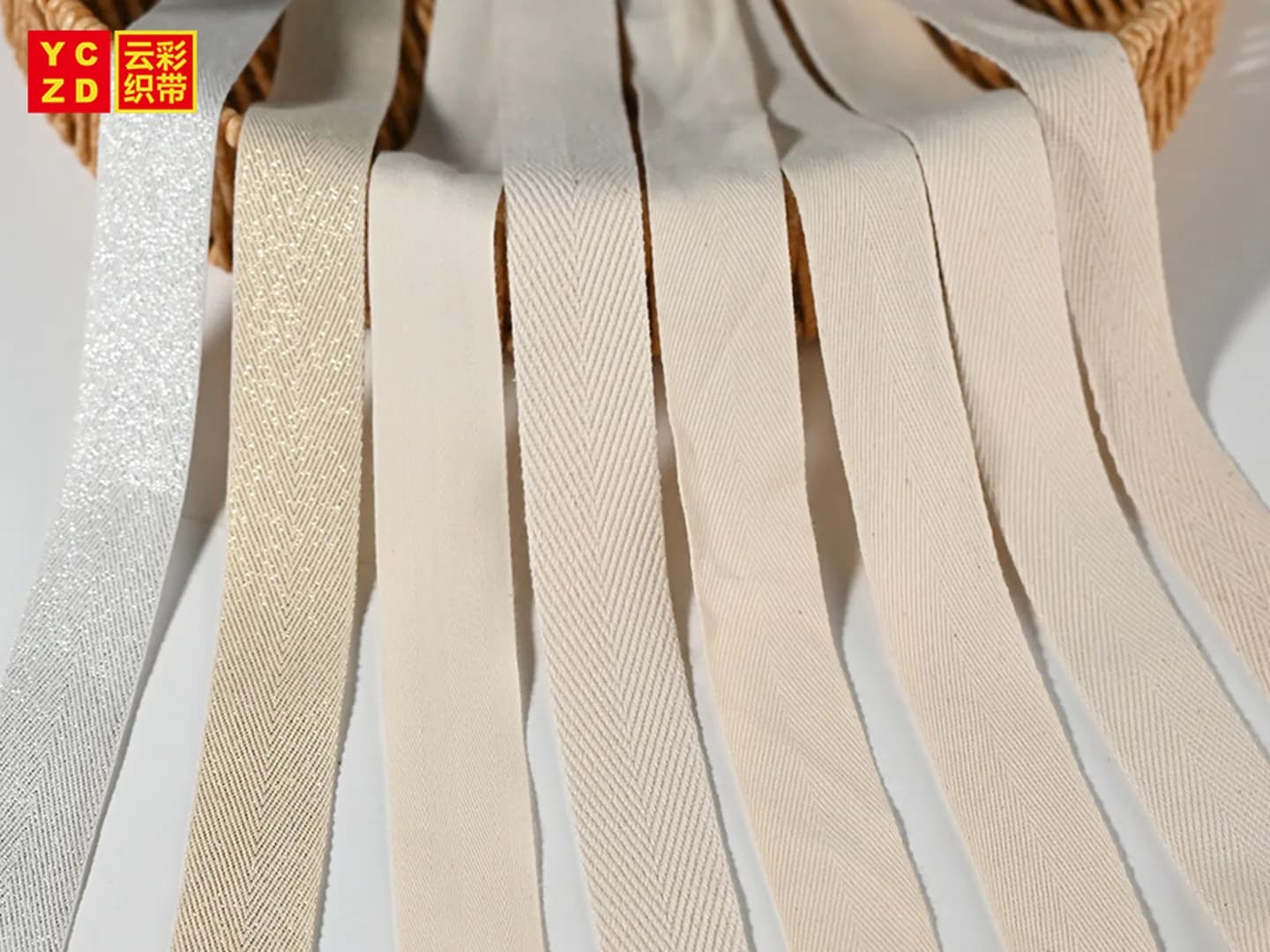
01Separate Weave, Fibre, Finish and Product Performance
A request for “cotton herringbone tape” contains more than one decision. The herringbone term describes a visible woven structure. Cotton describes a fibre requirement that still needs a documented composition. Dyeing, washing, softening, coating and other finishing choices can change colour and tactile feel. The finished trim then has to work in a seam, fold, binding, loop or reinforcement. Treating those four layers as interchangeable is the fastest way to approve the wrong sample.
The U.S. Federal Trade Commission’s Textile Fiber Rule requires specified disclosures for certain textile products sold in the United States, including generic fibre names and percentages by weight. The rule is a useful reminder that a weave name is not a fibre declaration. A natural-looking beige tape or a pronounced herringbone line cannot prove that the material is cotton, a blend or another fibre. Ask for the declared composition and the documentation required by the destination market and finished product.
Performance also cannot be read from the pattern. Two tapes can show similar broken diagonals yet differ in yarn size, density, width, thickness, finish and edge construction. Conversely, a plain-looking webbing may be the better choice when the design needs a visually neutral surface, a particular fold or dependable movement through a component. Start with the product requirement, then use structure as one selection variable.
- Weave: herringbone, plain or another identified construction.
- Fibre: declared generic name and percentage, not a visual guess.
- Finish: colour and any treatment that may alter tactile feel or care behaviour.
- End use: the seam, fold, contact surface and performance checks that matter.
02Read the Visible Structure Without Over-Promising It
CottonWorks describes twill weaves by their diagonal line and identifies herringbone as a variation of a balanced 2 x 2 twill in which the drawing sequence offsets to create a break. For a buyer, the practical visual cue is an interrupted or reversing diagonal rather than the uninterrupted over-under look associated with a basic plain weave.
That definition describes the geometry of interlacing, not a universal performance ranking. It does not mean every herringbone tape is softer, stronger, heavier or more premium than every plain tape. Those outcomes depend on the complete narrow-fabric design. The scale of the motif repeat, yarn contrast and finish can make the motif bold or almost invisible. Sample photographs should therefore record both the overall appearance and a close view under consistent lighting.
Use naming that a supplier can verify. CottonWorks distinguishes a pointed chevron pattern from the offset break of herringbone. If the exact motif matters, send a physical reference or a clear motif-repeat drawing and mark the approved face and direction. Do not rely on a style word alone when the visible line must align with a garment edge or centred feature.
| Decision | Herringbone tape | Plain-weave webbing |
|---|---|---|
| Visible structure | Broken or reversing diagonal is part of the design | Simple over-under interlacing gives a quieter grid |
| Buyer risk | Repeat scale, direction or break may not match the reference | Surface may still vary through yarn, density and finish |
| Approval evidence | Physical sample plus face, direction and repeat reference | Physical sample plus construction and finish reference |
This comparison concerns visible structure only. It is not a strength, comfort or durability ranking.
03Choose From the Application, Not From a Generic Preference
Map where the tape sits and what the customer touches or sees. Herringbone can be considered when the broken diagonal is part of the intended visual language on an apparel trim, binding, reinforcement or handle detail. Plain webbing can be considered when the surrounding design calls for a restrained surface or when the tape must disappear inside a construction. These are design directions to sample, not automatic rules about quality.
Next, trace the movement of the tape. Does it fold around a sharp edge, lie flat against lightweight fabric, pass through a loop, carry stitching close to its edge or contact skin? A tape that looks attractive on a sample card may twist, pucker the base fabric, show needle damage or feel bulky after folding. Make a representative assembly early, using the intended seam allowance, thread, stitch and adjacent material.
Separate decorative and structural roles. A neckline stay, binding or brand detail does not automatically use the same acceptance plan as a bag handle or load-bearing loop. If the complete product has a safety or load function, the buyer must define the product-specific evaluation and the person responsible for the decision. A weave label and a roll-level tensile result cannot by themselves approve a seam, attachment or finished product.
04Control Width, Thickness and Construction With Named Methods
Write finished width and the measurement condition into the specification. Clarify whether the tape is measured relaxed, after conditioning, before or after washing, and at which points across the roll. Record how an irregular or softly curved edge is treated. A nominal width without a method leaves room for the buyer and supplier to measure different states and still believe they are following the same requirement.
Thickness also needs a method because the pressure applied during measurement matters. The public scope of ISO 5084 describes determining textile thickness under specified pressure. The lesson for sourcing is not to copy a number from an unrelated fabric: identify the agreed method, instrument condition and target range for the intended tape. This is especially important when a fold, guide, seam or hardware opening has limited space.
Thread count or construction analysis can help distinguish an approved structure from a later substitute, but the method must suit the fabric. ISO 7211-2:2024 identifies three ways to determine threads per unit length and notes that method choice depends on fabric character. Buyers do not need to turn every RFQ into a laboratory specification. They do need an identifiable construction record when surface appearance or repeat consistency is critical.
- Finished width, measurement points, condition and permitted range.
- Thickness method and pressure where thickness affects assembly.
- Visible face, direction, repeat scale and reference location.
- Declared composition, yarn or construction code and finish reference.
- Roll format, winding direction and any cut-piece requirements.
05Validate Sewing, Folding and Edges on the Real Materials
Do not approve sewability from an unassembled tape alone. Stitch herringbone and plain candidates to the actual shell, lining or garment fabric with the proposed production thread, needle, seam type and stitch density. Compare material feeding, waviness, puckering, edge distortion, needle marks and the way the finished seam lies after handling. If the tape will bind a curve or fold back on itself, reproduce that geometry instead of testing only a straight strip.
Name or illustrate the seam rather than writing only “sewn on.” Buyer and supplier should identify the intended construction in the drawing or technical pack, then retain a representative approved assembly so production teams can compare the same result. Record the tape face, fold direction and stitch position because these details can change the visible result even when the roll material is unchanged.
Review edges and cut ends separately. The long woven edges may affect comfort, feeding and visual neatness, while the cross-cut end depends on the material and selected end treatment. A herringbone surface does not determine whether an end can be heat sealed. Confirm the actual fibre and construction, show whether the end is exposed or enclosed, and connect the decision to the previously approved cutting requirement.
06Build a Small Comparison Plan That Answers the Buying Decision
Create paired, identifiable samples rather than collecting unrelated swatches. Keep finished width, declared composition, colour direction and intended finish as comparable as practical, then vary the weave structure. If exact matching is not feasible, record every difference so a change in hand or sewing behaviour is not attributed to herringbone when yarn size or finish also changed.
Condition and test samples consistently when physical results will be compared. ISO 139 defines standard atmospheres for conditioning and determining textile physical and mechanical properties. ISO 13934-1 describes a tensile strip method for maximum force and elongation of textile fabrics and states its field of application and exclusions. Those public scopes show why a result needs a named method and sample condition; they do not create a universal pass value or prove that the method fits every narrow fabric.
Select only checks tied to the product risk. A decorative apparel binding may prioritise appearance, folding, sewing and care response. A strap component may add defined mechanical tests for the tape, seam and complete load path. Record the result as approve, revise or reject, with the reason. The objective is a traceable product decision, not a long test list copied from another programme.
| Review stage | What to compare | Record to retain |
|---|---|---|
| Unassembled tape | Pattern, face, direction, width, thickness, tactile feel and edge | Coded swatch and measurement method |
| Representative sewn assembly | Material feeding, seam appearance, folding, folded thickness and contact surface | Sewn sample tied to drawing revision |
| Relevant exposure | Agreed care, handling, abrasion or load check | Method, condition, result and decision |
| Production authorisation | First-production sample against the approved reference | Approval status, date and responsible reviewer |
Choose checks and acceptance criteria from the end use. No universal limit is supplied here.
07Herringbone Tape RFQ and Approval Checklist
A useful RFQ gives the supplier enough context to propose an identifiable construction without inventing missing requirements. State the finished product, tape location, visible role, requested material, width, colour, quantity by variant and destination market. Attach the reference image or physical tape, but identify which feature it controls: weave motif, colour, tactile feel, width or all of them.
Request a sample record that separates what is confirmed from what remains open. Approve the tape and representative sewn assembly with a revision, date and named reviewer. Connect the accepted reference to the bill of material, purchase order and quality plan. For repeat orders, require review before a change to fibre, yarn, weave, width, finish, dye route, edge construction or production site that could alter the approved result.
For the next enquiry, send the application photographs or drawing, target tape dimensions, declared composition requirement, desired herringbone or plain structure, colour reference, seam or fold detail, intended care procedure, test responsibilities and required supply format. Ask the supplier to flag feasibility questions and alternatives. Commercial terms should then be confirmed for that exact request rather than inferred from a photograph or generic product name.
- Finished product, tape location and decorative or structural role.
- Herringbone or plain structure, approved face, direction and repeat reference.
- Declared fibre composition and destination-market documentation.
- Finished width, thickness where relevant, colour and finish.
- Seam, fold, edge and cut-end construction with real adjacent materials.
- Sample stages, methods, person responsible for approval and retained reference.
- Quantity by colour or size, delivery form and change-notification requirement.
08Frequently Asked Questions
Is herringbone tape the same as cotton tape?
No. Herringbone describes a broken-twill weave structure; cotton describes a fibre. A herringbone tape may use cotton, a blend or another declared material. Confirm composition from documentation rather than appearance.
Is herringbone tape stronger than plain webbing?
Not as a universal rule. Strength depends on the full construction, including fibre, yarn, width, density, weave, finish and test condition. Compare production-intent samples with an agreed method and evaluate the finished seam or product where relevant.
What is the difference between herringbone and chevron tape?
Both show changing diagonal direction, but CottonWorks distinguishes herringbone by an offset break and chevron by a pointed reversal. If the motif matters, approve a physical sample or repeat drawing instead of relying only on the name.
Can a herringbone tape be used as garment binding?
It can be considered if the actual tape folds, feeds, sews, lies and feels acceptable in the intended garment construction. Test it with the proposed production fabric, seam geometry and intended care procedure; the weave name alone does not approve the application.
What should a herringbone tape specification include?
Include the application, declared composition, finished width, thickness where relevant, weave face and direction, repeat reference, colour and finish, edge and cut-end requirements, seam or fold construction, sample stages, agreed checks and change-notification rules.
09Continue From Guide to Specification
Compare the relevant product family and application page before sending your RFQ.
10Sources & further reading
Sources support the principles discussed; the final specification and test plan must follow the application and buyer requirements.
- Basic Woven Fabric DesignsCottonWorks by Cotton Incorporated
- Textile Fiber Rule, 16 CFR Part 303U.S. Federal Trade Commission
- ISO 5084:1996 — Determination of Thickness of TextilesInternational Organization for Standardization
- ISO 7211-2:2024 — Determination of Number of Threads per Unit LengthInternational Organization for Standardization
- ISO 139:2005 — Standard Atmospheres for Conditioning and TestingInternational Organization for Standardization
- ISO 13934-1:2013 — Maximum Force and Elongation Using the Strip MethodInternational Organization for Standardization