
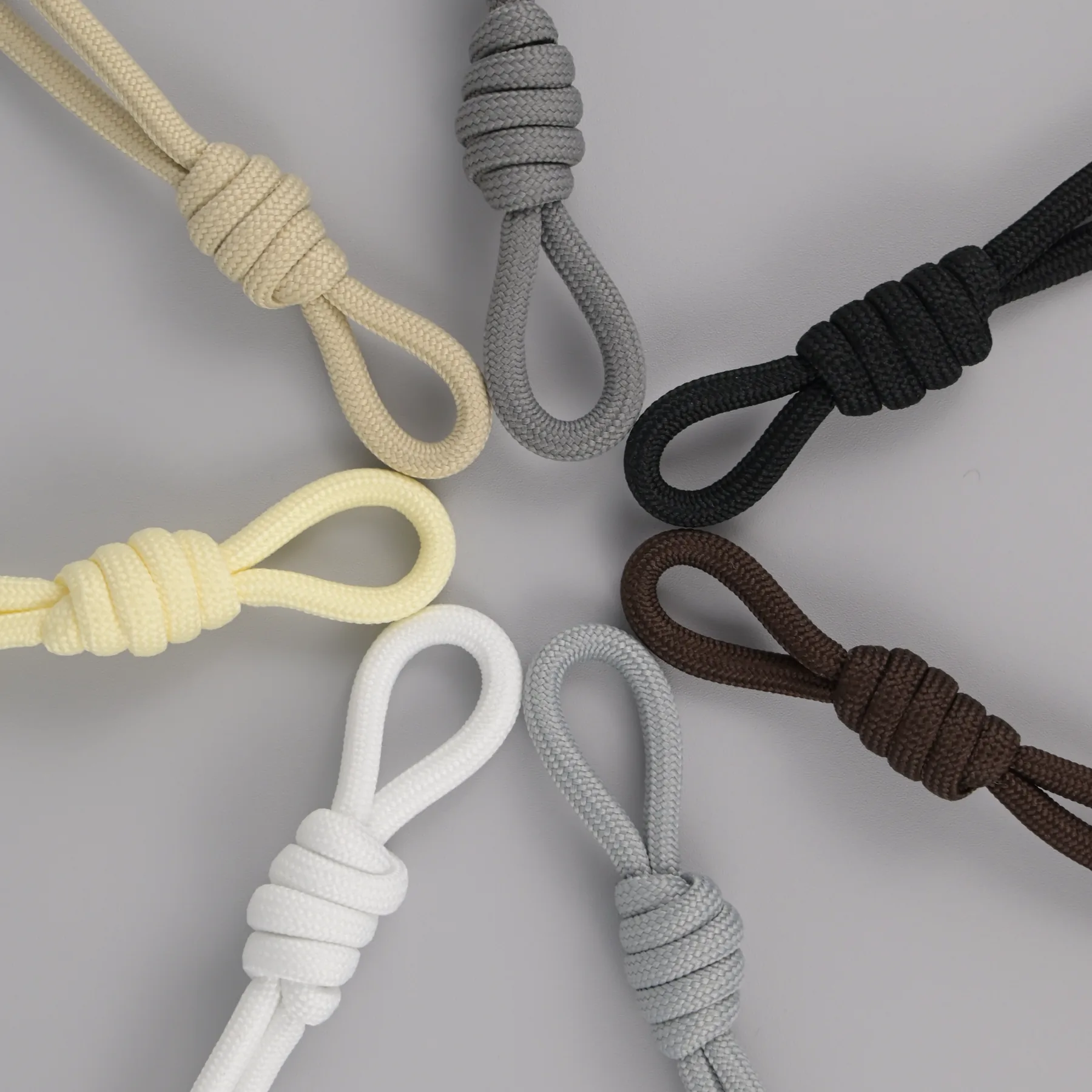
01Classify the Garment Before Specifying the Cord
A safe sourcing brief begins with the finished garment, not a cord catalogue. Record the intended market, product type, labelled size range, intended wearer, garment zone and purpose of every cord-like feature. A braided cord used to close a hood, a decorative bow, an elastic loop, a fixed tab and a fully retractable adjustment system may look related in a material list but can be treated differently by a safety requirement. The supplier cannot make a reliable decision from “kids drawcord, black, 4 mm” alone.
Map the feature on a front, back and side drawing. Show where it emerges, whether it runs through a channel, the maximum exposed portion in every adjustment state, the location of knots, toggles, aglets or other three-dimensional parts, and how the cord is anchored. Include the garment in its relaxed, fully opened and tightened conditions. If the style covers multiple sizes, review each size that can change cord exposure or the intended age classification.
Market classification must be explicit. A design accepted for one country should not be copied into another market based on a supplier’s general statement that it is “children safe.” The U.S. rule focuses on children’s upper outerwear and uses size equivalents. EN 14682-based programmes use age or height, garment zones and cord-type concepts. These frameworks are not interchangeable, so create one requirements row for each destination market.
- Target country or region and responsible brand or importer.
- Garment type, labelled sizes, intended age or height range and wearing layer.
- Cord location: head, hood, neck, upper chest, waist, lower edge, sleeve or another zone.
- Feature type and purpose: drawstring, functional cord, decorative cord, fixed loop, tab, belt or retractable system.
- All free ends, attachments, channels, anchoring points and adjustment states.
02Understand the U.S. Upper-Outerwear Rule Before Designing Details
The U.S. Consumer Product Safety Commission states that hood and neck drawstrings on children’s upper outerwear in sizes 2T to 12 or equivalent present a strangulation hazard and are a substantial product hazard. CPSC defines upper outerwear in its FAQ as clothing such as jackets and sweatshirts generally intended to be worn over other garments; the scope can include lightweight outerwear and is not limited to winter coats. When a style sits near the boundary, the product team should document why its garment classification and size equivalents are correct.
For waist and bottom drawstrings on children’s upper outerwear in sizes 2T to 16 or equivalent, CPSC guidance identifies a maximum of 3 inches outside the channel when the garment is expanded to its fullest width, no toggles, knots or other attachments at the free ends, and bartacking at the midpoint when one continuous string is used. Verify these conditions on the finished garment using the required measurement state; a purchase order that controls only cord cut length does not control the exposed configuration.
The current eCFR text at 16 CFR 1120.3 incorporates ASTM F1816-97 for this substantial-product-hazard rule. ASTM also lists F1816-18(2024) as the current active version of its safety specification. Do not silently substitute one edition for another: record which edition is legally incorporated, which current standard or customer specification is used for design review, and how any difference is resolved by the responsible compliance owner.
| U.S. screening question | Buyer evidence | Common sourcing error |
|---|---|---|
| Is it children’s upper outerwear? | Garment description, wearing layer, labelled sizes and size-equivalence review | Treating only heavy winter coats as outerwear |
| Is there a hood or neck drawstring? | Front, back and worn-state sample review | Shortening a prohibited feature instead of redesigning it |
| Is there a waist or bottom drawstring? | Fully expanded garment measurement and end-detail record | Approving loose cord length without the channel and garment |
| Is one continuous cord used? | Midpoint anchoring construction and production check | Relying on friction to stop the cord pulling through |
This is a screening matrix, not a replacement for the applicable regulation, incorporated standard or competent product-safety review.
03Build a Separate EN 14682 Review for UK and EU Programmes
Do not translate the U.S. size and garment-zone rules into centimetres and call the result an EN 14682 review. The European framework developed around cords and drawstrings across children’s clothing, with requirements differentiated by child group, garment area and cord type. The 2011 European Commission decision states that EN 14682 addressed strangulation, injury and entrapment risks and found the 2007 edition met the then general safety requirement for the risks covered. The legal framework and standard editions have evolved, so the current national adoption and market rules must be checked for the actual launch date.
A UK Office for Product Safety and Standards risk-assessment example updated in January 2026 applies EN 14682:2014 to a young child’s garment with decorative cords near the neck. It shows why teams must classify decorative features as carefully as functional adjustment cords: a bow or trim is not automatically outside a safety review. The source considers foreseeable entanglement around play equipment, doors, wheels and other everyday environments, rather than evaluating the cord only while the child stands still.
For an EN 14682-based brief, obtain the current full standard from the authorised standards body or compliance programme. Record the relevant child category, body zone and cord classification, then copy the applicable design and measurement requirements into the controlled style checklist. Do not reconstruct paid clauses from online summaries or reuse one checklist for every age group. Keep any UK, EU member-state, retailer or platform additions visible beside the base standard.
- Confirm the current national edition and the product-safety law or retailer programme that invokes it.
- Classify the intended child group using the required age, height and sizing evidence.
- Classify every cord by garment zone and by functional, decorative or other defined type.
- Review front, back, free ends, loops, attachments and adjustment states on the complete garment.
- Keep market-specific exceptions and customer rules separate from the U.S. checklist.
04Design Out the Hazard Before Optimising Cord Materials
The strongest design decision is often to remove the hazardous configuration rather than make a long cord slightly shorter. CPSC recommends alternative closures such as snaps, buttons, hook-and-loop systems and elastic instead of hood or neck drawstrings on children’s upper outerwear. Test whether the intended function—weather protection, fit adjustment, styling or easy dressing—can be achieved without a free-running cord in the relevant zone.
If a cord feature remains permitted for the intended market and category, control the geometry before discussing fibre or braid. Specify exit position, channel path, exposed length in each state, loop formation, anchoring, end construction and every attachment. A toggle, knot or three-dimensional end can create a snag point even when added only for appearance. An elastic feature can create a different entrapment or recoil issue, so replacing a cord with elastic still requires finished-product evaluation.
Material selection follows the approved configuration. Diameter, compressibility, surface friction, stretch, stiffness and end finish affect how a cord moves through a channel or cord lock and how much becomes exposed. Colour, reflective yarns, moulded ends and branded components may also change physical geometry. Treat each decorative or material revision as an engineering change, not a colour-only update.
| Design objective | Lower-risk question | Evidence at approval |
|---|---|---|
| Close or adjust a hood | Can a permitted fixed or alternative closure provide the function? | Worn-state fit and closure evaluation |
| Adjust a waist or hem | Can exposure and free-end geometry remain controlled in every state? | Relaxed, fully expanded and tightened measurements |
| Add a decorative bow or cord | Does it create a loop, free end or neck-zone entanglement risk? | Zone classification and foreseeable-use review |
| Add branded ends or hardware | Does the attachment create a snag point or alter retraction? | Complete assembly sample, not loose components |
A material sample cannot demonstrate the safety of a garment configuration that has not yet been defined.
05Approve the Complete Garment, Every Size and Every Adjustment State
A loose cord swatch can confirm colour, hand, construction and end quality, but it cannot confirm finished drawstring safety. Approve the cord in the actual garment with production-intent channels, openings, anchors, seams and attachments. Examine the garment laid flat, worn, fully opened and fully tightened. Pull the cord in realistic directions to see whether the midpoint shifts, a loop grows, an end passes through the channel or a component detaches.
Measure the finished feature using the method and garment state required by the applicable standard or programme. Record the instrument, measurement points, force or conditioning where required, sample size and result. Photographs should show the ruler or gauge and the complete garment identity. Do not create an internal pass number from this article; the acceptance limit must come from the current market requirement and controlled product specification.
Size grading can change channel circumference, cord length and the user category. Review the smallest and largest sizes and any intermediate size where construction changes. If a labelled range includes a covered U.S. size, CPSC explains that the garment can remain subject even when other sizes in the range would not be covered alone. Size labels, age claims and product descriptions should agree rather than being adjusted merely to avoid a safety requirement.
- Production-intent garment, cord, channel, anchoring, attachments and sewing thread.
- All labelled sizes and any construction break in the grade rule.
- Relaxed, fully expanded, tightened, worn and foreseeable pulled states.
- Required measurements, images, sample IDs, reviewer and approval date.
- Component retention, laundering or durability checks required by the applicable programme.
06Carry the Approved Geometry Into Production and Repeat Orders
Translate the approved configuration into measurable production controls. The bill of materials should identify the cord and every end or adjustment component. The technical pack should control cut length, channel path, exit location, anchoring method, bartack position where applicable, allowable exposed geometry and prohibited attachments. Inspection instructions should show the garment state and method, not merely say “check drawcord.”
First production output should be compared with the approved safety sample before the lot continues. In-process checks can target cord cutting, threading, midpoint anchoring, end finishing, toggle assembly and size labelling. Final inspection should sample across sizes and colours because different cord finishes or components can change friction and exposure. Keep failed or reworked samples in the traceability record rather than replacing the evidence with a new photograph.
For repeat orders, freeze the safety-critical fields. Obtain written approval before changing cord construction, elasticity, diameter, finish, cut length, end treatment, toggle, channel, anchoring, garment size or production method. Revalidate after an authorised change and when the applicable law, standard, destination market or customer requirement changes. An old passing report does not approve a new configuration.
| Control stage | Safety-critical record | Release question |
|---|---|---|
| Technical pack | Market, size scope, zone, cord type, drawing and acceptance source | Is the requirement unambiguous? |
| First output | Complete garment measurements and configuration photos | Does production match the approved sample? |
| In-process | Cut, threading, anchoring, ends, attachments and labels | Can drift create extra exposure or a loop? |
| Final and repeat order | Size-based inspection, change record and current requirement check | Is evidence valid for this lot and market? |
Keep the specification, approved garment, inspection record and any test or compliance file linked by item, revision, size and production lot.
07Children’s Clothing Cord and Drawstring RFQ Checklist
Send a configuration brief, not a generic cord enquiry. Include destination markets, garment description, size and age range, annotated drawings, cord purpose and zone, channel and anchoring details, components, required standard editions, test or inspection plan and approval responsibilities. Mark safety-critical dimensions and prohibited changes. If a decision has not been made, label it open rather than asking the factory to assume.
Ask the supplier to return a feasibility review and identify conflicts between the requested appearance and market-specific safety brief. Supplier experience can help find production risks, but the responsible brand or importer retains responsibility for determining applicable requirements and placing a safe product on the market. Independent testing or specialist compliance review may be proportionate where classification or interpretation is uncertain.
A clean approval path connects design, sourcing, compliance and production: classify the garment, select market requirements, design out hazardous configurations, approve the complete garment, verify production and control changes. Cord colour and price matter only after those gates are closed.
- Destination markets, responsible economic operator and launch date.
- Garment type, intended wearer, labelled size or age range and wearing layer.
- Annotated cord-zone drawings for every adjustment state and size break.
- Cord construction, dimensions, colour, finish, ends, attachments, channel and anchor.
- Applicable law, standard edition, customer programme and acceptance source.
- Sample stages, finished-garment checks, inspection frequency and change-approval owner.
08Frequently Asked Questions
Are hood drawstrings allowed on children’s jackets in the United States?
CPSC states that hood and neck drawstrings on children’s upper outerwear in sizes 2T to 12 or equivalent present a substantial product hazard. Confirm garment classification and size equivalence; use an appropriate alternative closure rather than assuming a shorter cord is acceptable.
Can one drawstring design be used for both U.S. and European children’s clothing?
Not without separate review. U.S. CPSC requirements and EN 14682-based programmes classify scope, sizes or child groups, garment zones and cord types differently. Build a market-specific checklist and approve the final garment against each applicable requirement.
Is a decorative cord outside children’s clothing safety rules?
Not necessarily. Decorative cords, bows, loops and attachments can create entanglement or strangulation hazards and may be expressly addressed by the applicable standard. Classify the feature by function, body zone and child group.
Is approving the loose drawcord enough?
No. A loose sample can confirm material details, but safety depends on the complete garment: channel, exposed length, loops, attachments, anchoring, size grading and all adjustment states.
Which ASTM F1816 edition should a buyer specify?
The U.S. eCFR substantial-product-hazard rule incorporates ASTM F1816-97, while ASTM lists F1816-18(2024) as the current active edition. The compliance owner should document the legally incorporated requirement, any current standard or customer requirement used for design, and how differences are handled.
09Continue From Guide to Specification
Compare the relevant product family and application page before sending your RFQ.
10Sources & further reading
Sources support the principles discussed; the final specification and test plan must follow the application and buyer requirements.
- Drawstrings in Children’s Upper Outerwear — Business GuidanceU.S. Consumer Product Safety Commission
- Business Guidance FAQ — Children’s Upper Outerwear DrawstringsU.S. Consumer Product Safety Commission
- 16 CFR 1120.3 — Products Deemed to Be Substantial Product HazardsElectronic Code of Federal Regulations
- ASTM F1816-18(2024) — Safety Specification for Drawstrings on Children’s Upper OuterwearASTM International
- Commission Decision 2011/196/EU on EN 14682 and Children’s Clothing Cords and DrawstringsEUR-Lex
- PRISM Risk Assessment — Non-Compliant Cords and Drawstrings in Children’s ClothingUK Office for Product Safety and Standards