
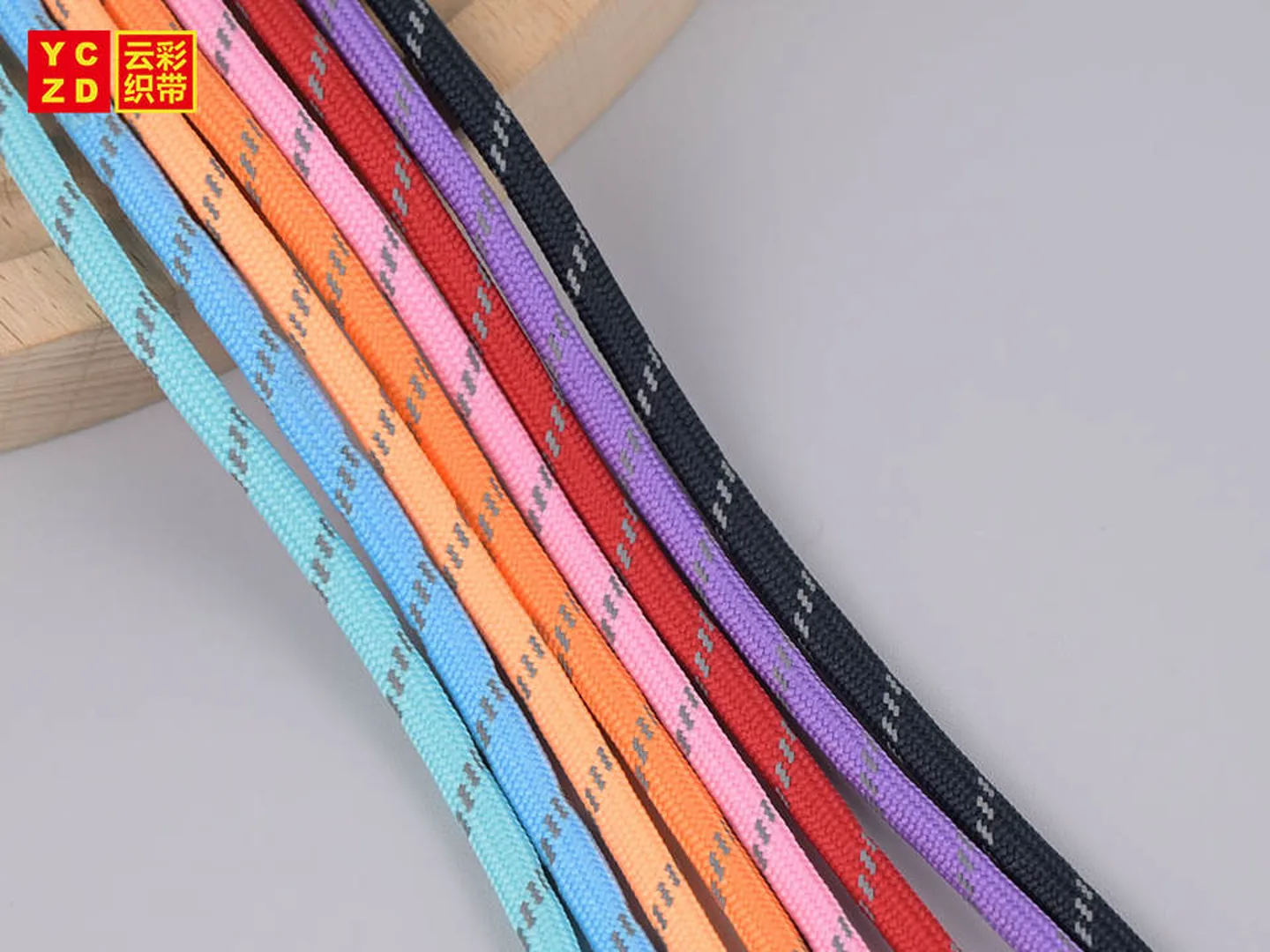
01Define the Visibility Objective Before Selecting a Cord
“Reflective drawcord” can describe very different buying intentions. A fashion team may want a detail that catches a camera flash. A running-shoe developer may want the lace or pull feature to support recognition when illuminated by vehicle headlights. A workwear programme may need the complete garment to satisfy a regulated high-visibility requirement. These are not interchangeable outcomes, so the brief should state who needs to see the product, under which lighting, from which directions and for what risk decision.
Retroreflection is more specific than ordinary shine. 3M explains that a retroreflective material returns light toward its source and appears brightest to an observer near that source. A metallic-looking or light-coloured yarn may reflect light diffusely or specularly without producing the same response. Daylight fluorescence, glow-in-the-dark effects and active lighting are also different technologies. Record the required effect instead of approving the word “reflective” on a quotation.
Decide the claim boundary early. ISO 20471 addresses high-visibility clothing for high-risk situations and combines colour and retroreflection performance with minimum-area and placement requirements. A small cord cannot, by itself, establish that a garment meets that standard. If a product is intended and marketed as PPE in the European Union, Regulation (EU) 2016/425 applies responsibilities to the complete equipment, its technical documentation and conformity route. Decorative or lifestyle visibility language must not imply a certified protective function that has not been assessed.
- Decorative effect: define the intended look and viewing conditions without making a safety claim.
- Enhanced recognition: define the user, environment, light source, directions and finished-product validation.
- Regulated visibility: identify the market, product standard, responsible conformity owner and required evidence.
02Control Viewing Geometry, Not Just Camera-Flash Brightness
A phone photograph with flash can be a useful screening record, but it is not a photometric measurement. Flash position, exposure, distance, image processing, cord curvature and background can make one sample look brighter than another. The CIE report on retroreflection defines measurement geometries and photometric terminology because a result only becomes comparable when the relationship between source, specimen and observer is controlled.
For a laboratory requirement, name the method or the material system’s approved procedure, observation and entrance geometry, specimen preparation, orientation and reporting unit. Avoid copying a coefficient from reflective sheeting or flat tape into a round or braided cord specification without confirming that the method can accommodate the specimen. Curved cords present different facets to the light, and patterned reflective elements may rotate out of the intended viewing direction.
Add a practical finished-product viewing review alongside any instrument result. Mount the cord exactly as used, then observe it from the required front, side and rear directions under defined low-light illumination and distance. Photograph the setup and record camera settings only as supporting evidence. The purpose is to detect blocked, twisted or discontinuous exposure; it does not replace a valid measurement when a quantitative claim is required.
| Evidence | Useful for | Cannot prove by itself |
|---|---|---|
| Flash photograph | Fast comparison of visible response in one recorded setup | A standard coefficient or all-angle performance |
| Material data sheet | Identifying the proposed reflective system and its stated conditions | Performance of a different cord or the final assembly |
| Laboratory result | Quantified performance for the named specimen and geometry | Visibility of every finished-product design or use condition |
| Finished-product review | Checking exposure, orientation, movement and obstruction | Compliance unless the applicable conformity programme is completed |
Keep the specimen identity, setup and decision rule attached to every result so evidence is not reused beyond its scope.
03Identify the Cord and Reflective Construction as One System
Two cords can look similar in a daylight image while using different reflective constructions. The effect may come from a reflective yarn integrated into the braid, a wrapped element, a printed or coated surface, or another converted component. Ask the supplier to identify the proposed construction and source reference at the level needed for repeat orders. Do not infer polyester, nylon, glass beads or a performance class from grey flecks in a photograph.
Control the textile body as well. State the declared fibre composition, braided or knitted structure, finished diameter or width, elasticity where relevant, hand, colour, pattern repeat, linear density if useful, and relaxed measurement condition. For cords passing through eyelets, toggles or lace hardware, evaluate the complete tolerance range rather than one ideal sample. A reflective element can change surface friction, bending stiffness and apparent diameter.
Define the face and direction of any patterned construction. A flat cord may have a preferred visible face; a round cord may rotate during lacing or adjustment. Mark the intended orientation on the drawing and decide whether rotation is acceptable. If multiple cord pieces appear together, review daytime colour and low-light appearance as a set, because lot or construction differences can become more noticeable when illuminated.
- Cord item, construction revision and reflective component reference.
- Declared fibre composition and any elastic element.
- Finished dimensions, measurement condition and tolerance.
- Daylight colour, low-light appearance and permitted lot variation.
- Surface friction, flexibility, face, direction and rotation behaviour.
04Map the Installed Exposure Through the Real Assembly
Draw the complete visible path. On a hood, the cord may disappear into a casing, knot, stopper or folded channel. On footwear, eyelets, crossings, a tongue and the wearer’s trousers can cover much of a lace. A heel pull loop can fold against the upper when it is not being held. Measure and review what remains exposed in the normal worn state rather than using the uninstalled cord length as the visibility area.
Check the assembly for damage and obstruction. Needles, clamps, sharp eyelets, moulded tips, adhesives, heat and cutting can disturb the reflective surface or change cord geometry. Build a representative sample using production-intent fabric, hardware, seam, tension and end treatment. Inspect the entry and exit points, tight bends and high-rub zones after repeated adjustment.
Preserve the product’s main function. A hoodie drawcord still needs suitable hand, adjustment and end management; a shoelace must lace, knot and release as intended; a pull tab must fit the user’s grip and attachment design. Reflective appearance does not justify adding stiffness, roughness, snagging or an unsuitable free-end hazard. Children’s clothing and other regulated products require their own product-specific safety review in addition to visibility evaluation.
05Validate Performance After Relevant Use and Care
Initial brightness is only the starting point. Abrasion can affect exposed elements; bending and knotting can create local wear; dirt and oils can cover the surface; water can change appearance; and laundering, drying or heat can alter the textile or reflective construction. Select exposures from the actual product rather than applying a generic “washable” label.
ISO 6330:2021 provides multiple domestic washing and drying procedures for textile testing and notes that machine, detergent and drying parameters can affect results. Therefore, “tested after washing” is incomplete. Record the washing procedure, detergent, drying route, number of cycles, specimen state and the performance evaluated afterwards. If the finished product has a care label, the component plan should support that complete care route.
Material-supplier instructions are also specific. A 3M technical data sheet for its reflective fabric family lists different care recommendations by product and warns that harsher cleaning can reduce performance. That document is not a specification for an unidentified drawcord; it demonstrates why a buyer must obtain the data sheet for the exact proposed reflective component and validate it in the actual textile construction.
Use a staged durability matrix. Screen the loose cord after flexing, abrasion or care exposures that represent foreseeable use, then repeat the relevant appearance or photometric assessment. Test critical assembled zones such as eyelet contact, knots, end treatments and stitched loops. Define the failure mode to record: loss of retroreflective response, peeling or breakage of the reflective element, colour change, fraying, dimensional change, poor adjustment or another application-specific issue.
| Exposure | Specimen to review | Post-exposure decision |
|---|---|---|
| Repeated bending or knotting | Loose cord and installed bend zones | Reflective continuity, cracking, hand and function |
| Abrasion at hardware | Cord with production-intent eyelet, toggle or guide | Surface wear, fraying, drag and visibility response |
| Domestic care | Finished product or representative assembly | Appearance, dimensions, function and measured response |
| Water, dirt or weathering where relevant | Application-specific exposed zones | Temporary and retained response under the agreed condition |
The buyer should define severity and acceptance criteria from use, claim and market requirements; this table supplies no universal limit.
06Approve Development, Pre-Production and Bulk Evidence Separately
Give each sample a decision purpose. A construction sample confirms braid, diameter, hand and reflective-component direction. A colour sample confirms daylight appearance and a controlled low-light reference. An assembly sample checks routing, knots, hardware and end treatment. A pre-production sample confirms the final materials and settings. Avoid one unlabelled “golden sample” that is expected to answer every technical and compliance question.
Keep traceability between evidence and production. Record the cord item and revision, material and reflective-component lots where required, colour lot, sample date, assembly revision, test specimen identity, method, result and approval owner. If the supplier proposes a replacement yarn, coating or source, require notification and reassessment before use. Similar daylight colour does not establish equivalent low-light behaviour or durability.
For regulated claims, the responsible product manufacturer must control the formal technical documentation and conformity route. For lifestyle products without a protective claim, retain a proportionate file that supports the actual words used in marketing. In both cases, make the scope visible: the evidence applies to the identified component, assembly, exposure and decision—not to every future cord that looks similar.
07Reflective Drawcord RFQ and Approval Checklist
A comparable quotation requires suppliers to see the same product context. Send a marked drawing or tech pack, reference sample, intended user and environment, claim boundary, required cord construction, dimensions, colour, reflective component direction, exposed path, hardware, end treatment, quantity by variant, sample stages, care route, test or documentation requirements, packing and target milestone. Mark unknown fields as open for a documented proposal instead of hiding them behind “same as photo.”
Ask the quotation to identify the proposed cord and reflective-component references, assumptions, exclusions, sample stages, available evidence and changes that would require reapproval. Close the highest-risk decisions before bulk material is committed. The goal is a repeatable component that works in the product and supports only the visibility language the evidence can justify.
- Use case, target market and decorative, enhanced-recognition or regulated claim.
- Cord construction, composition, dimensions, elasticity, colour and reference sample.
- Reflective component identity, pattern, face, direction and supplier data sheet.
- Installed path, exposed length, orientation, hardware, seam and end treatment.
- Measurement method, geometry, specimen, units and acceptance criteria where quantitative evidence is required.
- Flex, abrasion, care and environmental exposures matched to foreseeable use.
- Development, assembly, pre-production and bulk approval responsibilities.
- Lot traceability, change notification, packing and record requirements.
08Frequently Asked Questions
Does a reflective drawcord make a garment high visibility?
No. High-visibility standards such as ISO 20471 assess the complete garment, including material performance, colour, minimum areas and placement. A small reflective cord can be one design detail, but it does not establish garment classification or compliance by itself.
Can I approve reflective cord performance from a flash photo?
Use a flash photo only as a screening record under a documented setup. Camera position, exposure, distance, cord orientation and processing change the image. Quantitative claims need an agreed method, geometry, specimen and acceptance criterion.
What should be tested after washing?
Repeat the characteristics that the care exposure can affect: reflective response, visible continuity, colour, dimensions, surface condition, hand, adjustment, knots, end treatments and assembly. State the washing and drying procedure, detergent, cycles and specimen condition rather than saying only “wash tested.”
Should the loose cord or finished product be tested?
Usually both, for different decisions. Loose-cord evidence controls the identified material and construction. Finished-product evidence captures curvature, rotation, coverage, eyelet abrasion, stitching, knots, end treatment and the actual visible path.
What information is needed for a reflective drawcord quotation?
Provide the use, target market, claim boundary, cord construction and dimensions, colour, reflective reference, visible routing, hardware, end treatment, quantity, care route, sample stages and evidence required. Ask the supplier to list assumptions and any component changes that trigger reapproval.
09Continue From Guide to Specification
Compare the relevant product family and application page before sending your RFQ.
10Sources & further reading
Sources support the principles discussed; the final specification and test plan must follow the application and buyer requirements.
- How 3M Scotchlite Reflective Material Works3M
- CIE 054.2:2001 — Retroreflection: Definition & MeasurementInternational Commission on Illumination
- ISO 20471:2013 — High visibility clothing — Test methods and requirementsInternational Organization for Standardization
- Regulation (EU) 2016/425 on personal protective equipmentEuropean Union
- ISO 6330:2021 — Domestic washing and drying procedures for textile testingInternational Organization for Standardization
- 3M Scotchlite Reflective Material Fabrics — Technical Data Sheet3M