

01Start With Manufacturing Scope, Not a Product Photo
The first sourcing mistake is asking whether a factory “makes webbing” as if webbing were one product. A narrow-textile supplier may be strong in woven tapes but less experienced with knitted elastic, braided cord, jacquard logos, silicone finishing or a particular edge construction. A broad catalog proves range, not competence in your exact item. Begin by defining the construction and end use, then ask the supplier to explain which steps are performed in-house, which are subcontracted and which details usually create risk.
A useful scope statement includes the application, approximate width and thickness, base fibre or fibre options, stretch requirement, colour direction, logo or pattern, surface finish, hardware interface and any regulatory or buyer-specific requirements. If you have an existing sample, describe which features must be matched and which can change. If you only have a concept, say so. A reliable technical team should separate confirmed requirements from assumptions rather than quietly converting every blank field into its own default.
Evidence matters. Ask for photographs or a live video of relevant equipment and the sample-development area, but do not treat a polished factory tour as proof of process control. Follow the visual evidence with questions: How is the specification recorded? How is yarn or colour identified? Who approves the first sample? What is compared during bulk inspection? These questions reveal whether the supplier can turn a visual request into a repeatable production reference.
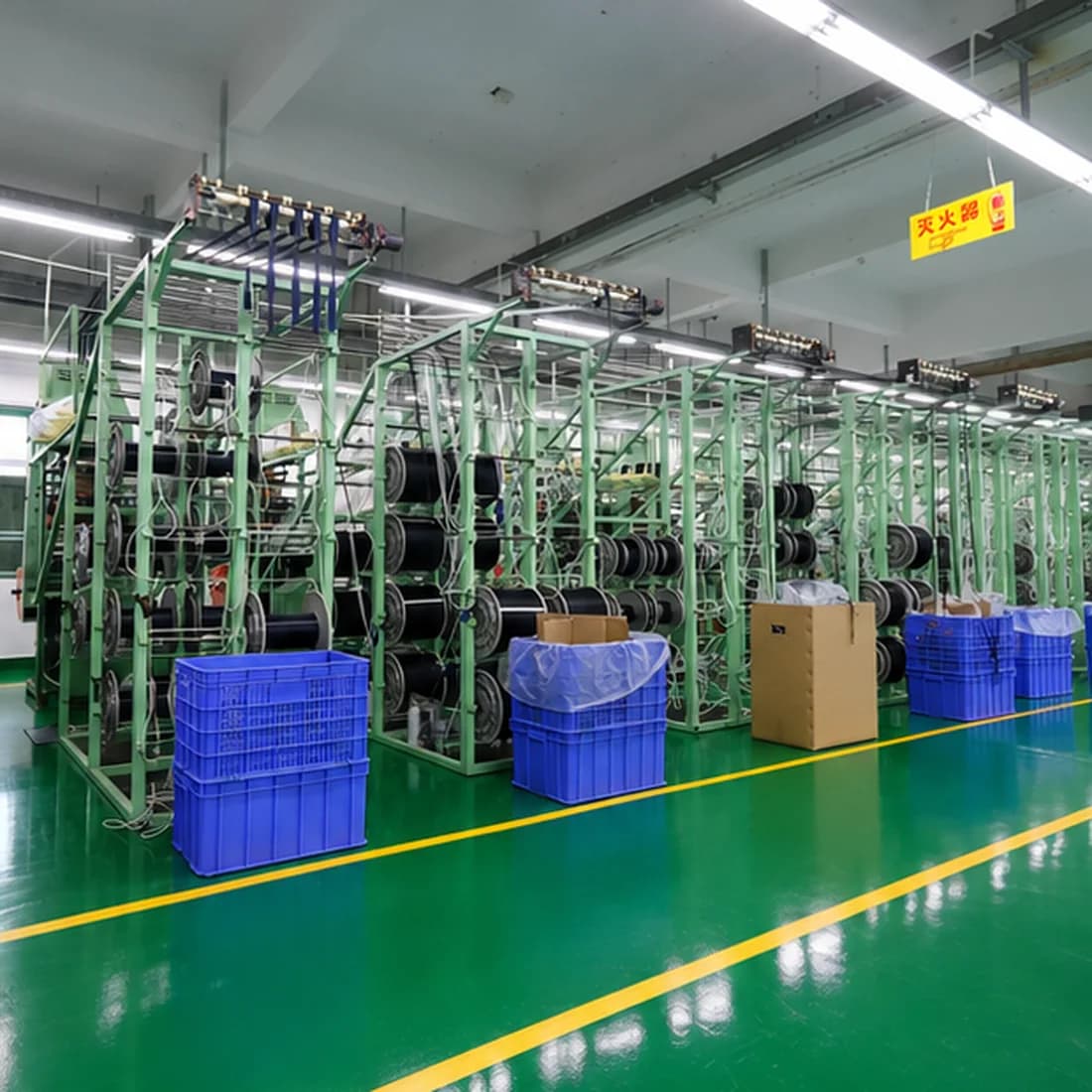
- Ask which constructions and finishing processes are genuinely routine for the supplier.
- Identify outsourced dyeing, finishing, printing, coating or testing steps and who controls them.
- Request evidence related to your product category, not unrelated factory highlights.
- Record every open technical assumption before price comparison.
02Test the Quality of the Technical Conversation
The quality of the first technical conversation is often more predictive than the speed of the first quotation. A capable supplier should ask what the webbing will do, not only what it should look like. Bag handles, shoulder straps, underwear waistbands, garment labels, footwear loops and outdoor tie-down components place different demands on yarn, weave or knit, elongation, hand feel, abrasion, colourfastness and edge behaviour. The same photograph can therefore lead to several valid constructions with different costs and performance trade-offs.
Listen for questions about how the component will be sewn, folded, bonded or threaded through hardware. A strap that repeatedly bends around an adjuster may require different evaluation from a decorative tape stitched flat onto a garment. Skin-contact elastic needs attention to softness, edge pressure, recovery and care conditions. A logo jacquard may need artwork simplification or a revised repeat to remain legible at the chosen width. The supplier does not need to dictate your product, but it should surface the decisions that affect manufacturability and use.
Good technical communication is specific about uncertainty. For example, fibre identity cannot be confirmed from a photo, screen colour is not a production colour standard, and a hand-pulled stretch impression is not a controlled test. A trustworthy reply will request a physical reference, target range or agreed test method where necessary. Treat unsupported certainty as a warning sign, especially when the item has safety, compliance or brand-critical requirements.
| Buyer provides | Supplier should clarify | Approval evidence |
|---|---|---|
| End use and assembly | Load, contact, wash, abrasion and hardware conditions | Application-specific sample or test plan |
| Material direction | Fibre options, hand feel, colour and moisture trade-offs | Declared composition and approved sample |
| Dimensions | Width, thickness, tolerance and measurement method | Measured sample and signed specification |
| Artwork or reference | Repeat, edge, logo detail and colour limitations | Approved artwork and physical colour reference |
| Order assumptions | Quantity, packing, destination and timing dependencies | Written quotation with exclusions and validity |
This is a sourcing framework, not a universal test specification. The final controls should follow the product, market and buyer requirements.
03Control Sampling Like a Small Production Project
A sample is valuable only when both parties know what it represents. A showroom swatch can demonstrate general capability, but it does not approve your colour, dimensions, construction or performance. A custom development sample should have an identity: revision number, date, material declaration, width, thickness or weight where relevant, colour reference, artwork version and notes about any temporary substitutions. Without that record, teams may approve different samples while using the same informal name.
Build a sample scorecard before the parcel arrives. Review appearance under consistent lighting, measure dimensions using an agreed method, compare edge quality, bend or stretch the component as it will be used, and assemble it with the actual fabric or hardware when possible. Record results with photographs and written comments. “Looks good” is not a reproducible approval. “Approved against sample A2, except the red must match physical standard R-03” gives production and quality teams something actionable.
Do not ask one sample to prove what it cannot prove. A development sample may be made on a small setup or from available yarn to confirm construction, while a pre-production sample may be needed to confirm production colour and process. Performance testing should use material made under representative conditions. Clarify which stage you are approving, what can still change and whether another approval gate is required before bulk production.

- Give every custom sample a revision ID and preserve the approved reference.
- Approve measurable attributes and named exceptions, not a vague overall impression.
- Test the webbing in the final assembly whenever hardware, seams or skin contact affect performance.
- State whether the sample is developmental, pre-production or a sealed bulk standard.
04Review the Quality System Behind the Certificate List
Certificates can support due diligence, but the logo on a PDF is not the quality system. Verify the legal entity, site address, standard, scope, issuing body, issue date and expiry date. A quality-management certificate may describe a management framework; it does not automatically certify every product or guarantee that your order meets a performance requirement. Product-related labels and recycled-content claims have their own scopes, transaction or chain-of-custody rules and documentation needs.
ISO explains quality assurance as planned and systematic activity that gives confidence requirements will be fulfilled. In practical sourcing terms, ask how the factory translates your approved requirements into purchasing, production, inspection and release. Useful evidence includes an order specification, incoming-material identification, in-process checks, final inspection criteria, nonconformance handling and retained records. The goal is not paperwork for its own sake; it is to reduce the chance that critical information disappears between sales, sampling and production.
Ask for a sample inspection record with confidential details removed. Does it identify the item and revision? Are measurements tied to tolerances? Are visual criteria clear? Who signs the result, and what happens when a result is outside the agreed limit? A supplier that can explain a normal corrective-action path is often more credible than one that claims defects never occur. Manufacturing always contains variation; professional control is the ability to detect, contain, investigate and prevent unacceptable recurrence.
- Match certificate entity, location and scope to the factory and product in your purchase.
- Confirm whether a claim applies to the organization, the process, the material or the specific order.
- Review an example of specification control, inspection and nonconformance handling.
- Define what evidence will accompany recycled, organic or restricted-substance claims when required.
05Check Traceability and Change Control
Traceability does not need to be complicated to be useful, but it must connect the finished webbing to the information that matters. Depending on risk, that may include yarn supplier or lot, dye lot, machine or production date, operator team, inspection record and packing batch. Ask the manufacturer to walk through how it would investigate a colour, width or stretch complaint after shipment. If the team cannot identify what was produced together, containment becomes slow and every carton may be treated as suspect.
Change control is equally important. Yarn availability, dye formulation, finishing routes, machinery, subcontractors and packaging can change. Some changes are harmless; others alter hand feel, shade, shrinkage, recovery or visual appearance. Your purchase terms should state which attributes and process changes require notice and re-approval. The approved sample is useful, but it should be supported by a written specification so that an invisible material or process substitution is not accepted merely because the product looks similar at first glance.
For repeat orders, ask what is retained: physical sample, digital artwork, colour standard, bill of material, machine settings or inspection history. Also clarify the limits of repeatability. Textile colour and hand can vary across lots, so define an acceptable range and viewing method rather than demanding an undefined “exact” match. A mature supplier will discuss how repeat orders are controlled and which variables still require buyer confirmation.

06Compare Commercial Terms Without Hiding Technical Differences
A low unit price can result from an efficient construction, but it can also reflect a different material, looser tolerance, simpler packing, excluded testing or an unrealistic quantity assumption. Normalize quotations before comparing them. Each supplier should quote against the same revision and state material, width, thickness or weight if relevant, colour count, artwork, finishing, quantity, packing, Incoterm, destination assumptions, sample charges, tooling or setup, testing, payment terms and quotation validity.
MOQ and lead time should be treated as outputs of a defined project, not universal marketing numbers. Custom-dyed yarn, jacquard setup, special finishing, packaging and testing may each create their own minimum or schedule dependency. Ask the supplier to identify the constraint and possible alternatives. Combining colours, choosing an available yarn, adjusting packing or separating development from production may change the answer, but each option has a consequence that should be documented.
Look for a realistic timeline with approval gates. “Twenty days” is ambiguous if the clock starts only after artwork, colour, payment and sample approval. Create a simple milestone plan covering technical confirmation, sample production, buyer review, material booking, bulk production, inspection, packing and shipment. Add time for iteration. Fast communication is helpful, but a promise that ignores approvals and material availability is not a reliable schedule.
| Commercial field | Why it changes the comparison | Question to ask |
|---|---|---|
| Unit price | May represent different construction or exclusions | Is this price tied to the same specification revision? |
| MOQ | Can be driven by yarn, dyeing, setup or packing | What creates the minimum, and what alternatives exist? |
| Lead time | Depends on approvals, material and production capacity | What is the start point and which milestones are included? |
| Testing | External laboratory and sample preparation add cost and time | Which tests, methods and acceptance limits are included? |
| Incoterm | Changes freight, risk and destination cost | Which named place and version of the Incoterm apply? |
07Use Communication and a Pilot Order as Final Evidence
Communication quality is not perfect English or instant replies. It is the ability to preserve meaning across time zones, departments and revisions. Strong suppliers recap decisions, label attachments, identify open points and avoid mixing price, sample and production versions. During qualification, change one controlled detail and see whether the new revision appears consistently in the quotation, sample note and later confirmation. This small test exposes weak document control before the order becomes large.
For a new supplier or high-risk design, consider a commercially sensible pilot order. Define the same inspection and packing requirements intended for larger orders. A pilot is not permission to ignore controls because the quantity is small; it is an opportunity to verify them with limited exposure. Review how the factory handles material confirmation, production updates, deviations, inspection evidence, packing marks and shipping documents. Record lessons and update the next specification.
Also evaluate how problems are discussed. A useful supplier raises uncertainty early, proposes options with consequences and documents the chosen route. If every question receives “no problem,” ask for the evidence, method or sample that will prove it. The objective is not to find a supplier that never says no. It is to find one that can say what is feasible, what remains unproven and what must be decided before production.
- Expect written recaps with revision-controlled attachments and a visible open-point list.
- Use a pilot order when risk justifies testing the full order workflow.
- Score response quality, not only response speed.
- Prefer early disclosure of constraints over late reassurance.
08The 12-Point Webbing Manufacturer Evaluation Checklist
Use the following checklist as a decision record rather than a yes-or-no form. Weight each item according to product risk. A decorative garment tape may need strong colour and appearance control, while a load-bearing or safety-related component requires specialized engineering, testing and regulatory review beyond this general guide. Record evidence, owner and next action for every unresolved point.
No supplier needs to be perfect at the first contact. What matters is whether the team can close gaps transparently before approval. If several items remain based only on promises, keep the supplier in evaluation. If the product requirement itself is unclear, pause price negotiation and improve the brief. Better inputs usually produce more comparable quotations, more useful samples and fewer disputes.
- 1. Legal entity and manufacturing location are confirmed.
- 2. Relevant construction and process capability are demonstrated.
- 3. End-use risks and assembly conditions are understood.
- 4. Material, dimensions, colour, artwork and finish are documented.
- 5. Sample stages and approval evidence are controlled.
- 6. Quality certificates are verified for entity, scope and validity.
- 7. Inspection methods, tolerances and acceptance criteria are agreed.
- 8. Traceability and nonconformance handling are workable.
- 9. Material or process changes require appropriate notice and approval.
- 10. Price, MOQ, lead time, testing and Incoterm assumptions are normalized.
- 11. Communication preserves revisions and open decisions.
- 12. A pilot or first-order review confirms the end-to-end workflow.
09Frequently Asked Questions
What should I ask a custom webbing supplier first?
Start with the end use, assembly, material direction, dimensions, colour or artwork, quantity and destination. Then ask which details the supplier needs to confirm construction and sampling. This reveals technical competence more effectively than requesting a price from a photo alone.
Does ISO 9001 certification guarantee good webbing?
No. ISO 9001 concerns a quality-management system and its scope should be verified. It can support supplier evaluation, but it does not replace an approved product specification, sample, appropriate testing, inspection and order-specific evidence.
How many samples should I request before bulk production?
There is no universal number. Use as many controlled stages as the risk requires: an initial construction sample, a revised approval sample and, where colour or process matters, a representative pre-production sample. Define what each stage proves before approving it.
How do I compare two webbing quotations fairly?
Issue the same revision to both suppliers and normalize material, construction, dimensions, tolerances, colour, finishing, quantity, packing, testing, Incoterm, tooling, payment and timing assumptions. A unit price without these fields is not a like-for-like comparison.
Should I always place a pilot order with a new factory?
A pilot is useful when the expected volume, technical uncertainty or business impact justifies it. It should exercise the real specification, inspection, packing and communication workflow. Very low-risk standard items may be qualified through other proportionate evidence.
10Sources & further reading
Sources support the principles discussed; the final specification and test plan must follow the application and buyer requirements.
- ISO 9001 explainedInternational Organization for Standardization
- Quality management principlesInternational Organization for Standardization
- OEKO-TEX STANDARD 100OEKO-TEX
- Global Recycled StandardTextile Exchange
- Creating helpful, reliable, people-first contentGoogle Search Central