
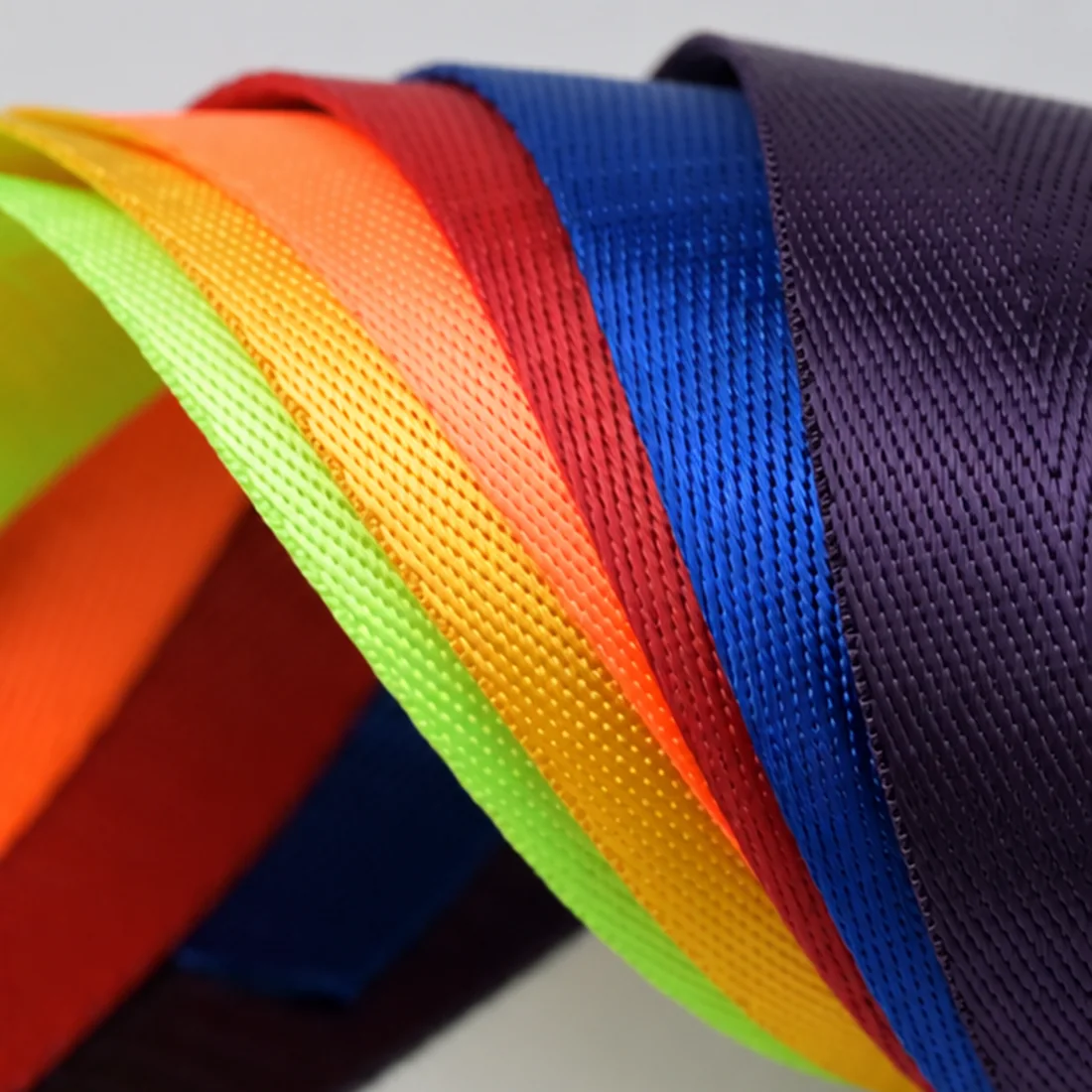
01Treat Webbing Construction as a System, Not One Number
A buyer may receive two tapes with the same nominal width and colour but different coverage, hand, edge behaviour and sewing response. The difference can come from fibre, yarn form and linear density, the number and arrangement of warp ends, the pick count, weave, edge construction, finishing, moisture state or measurement pressure. A single label such as “heavy webbing” or “high density” cannot preserve that combination.
Begin with the decision the construction record must support. Development teams may need to reproduce an approved appearance, fit a buckle, keep a fold compact or control a branded pattern. Quality teams may need objective incoming checks. Purchasing may need to compare offers without silently changing the article. These purposes can share one controlled sheet, but every field needs a defined unit, method and specimen state.
Separate identity from performance. Construction fields describe what the tape is and how it is measured; they do not automatically prove breaking force, abrasion resistance, colourfastness, dimensional stability or service life. Add only the application-specific tests that answer the finished-product risk, and keep their results linked to the exact sample and revision.
- Identify the face, reverse, warp direction, edges and finished state before measuring.
- Record declared fibre and yarn system without inferring composition from appearance.
- Use consistent units and name the test method or agreed work instruction.
- Link measurements to a sample code, colour, finish, date and revision.
02Distinguish Warp-End Count From Pick Count
In a woven tape, warp ends run along the production length and filling or weft picks cross the width. They are different controls. A warp-end statement may describe the total ends across a narrow finished width, ends per centimetre or separate groups used for the body, edges and pattern. A pick statement is normally expressed per unit length. The construction sheet must state the orientation, unit and whether edge or binder yarns are included.
ASTM D3775 covers end and pick counts for woven fabrics and explicitly addresses narrow fabrics: the count across the total width can be measured in the narrow direction and extrapolated to yarns per centimetre or inch. ISO 7211-2:2024 specifies three approaches for threads per centimetre, with the choice depending on fabric character; its public abstract notes that dissection is suitable for all fabrics and is especially relevant to some folded or complicated weaves. The method name therefore matters when a visual count is obscured by structure.
Do not treat a higher count as an automatic quality grade. More visible yarns can result from finer yarn, multiple yarns acting together, a different weave or a different counting convention. The buyer needs reproducible identity and functional fit, not the largest number on a supplier sheet. If two laboratories disagree, first compare specimen location, orientation, included edge elements, units and method before changing an acceptance limit.
| Construction field | Record explicitly | Common ambiguity to prevent |
|---|---|---|
| Warp ends | Total across width or count per unit, including stated edge treatment | Body, edge and binder ends may be counted differently |
| Weft picks | Picks per centimetre or other agreed unit in finished state | Unit length and compacted or relaxed state may differ |
| Weave or pattern | Diagram, repeat, face/reverse photographs or approved reference | The same counts can be arranged into different structures |
| Measurement locations | Number and position of readings along the sample or roll | Local pattern or edge zones may not represent the whole tape |
03Record Yarn Identity and Linear Density Separately From Count
Thread count says how many yarn paths are present; it does not say how much material each path contains. Record the declared fibre, filament or spun form, single or plied construction and linear-density unit where those details control the product. If supplier terminology differs, retain the original unit and document any conversion rather than rounding several yarn descriptions into one generic “size.”
ISO 7211-5:2020 covers the determination of linear density for yarn removed from fabric when the yarn is of nominally uniform linear density. Its public abstract describes removing threads, determining their straightened length and measuring their combined mass. That scope is useful for reverse analysis, but it does not mean every decorative, elastic, textured or multi-component webbing yarn can be reduced to one dependable value by inspection alone.
Treat covered elastomeric yarns, textured filaments, bulked yarns and pattern groups as identified systems. State which element the value belongs to and whether the figure is nominal supplier information or a measured result. Preserve an approved cross-section or yarn map when it explains the structure better than prose. Never infer fibre composition or recycled content from yarn size, colour or hand.
- Declared fibre and yarn form for each functionally different group.
- Original linear-density unit, nominal value and source of the information.
- Single, plied, covered, textured or grouped construction where relevant.
- Body, edge, binder, pattern and elastic elements identified separately.
- A physical reference retained when analysis cannot fully describe the yarn system.
04Use Mass, Width and Thickness as Complementary Checks
Mass can reveal a construction change that width alone misses, but its basis must be clear. ASTM D3776/D3776M-20(2025) covers fabric mass per unit area and includes an option intended for narrow fabrics. A webbing supplier may also use mass per unit length because the commercial product has a controlled width. These are not interchangeable unless the actual finished width, unit system and calculation basis are recorded.
A small swatch does not necessarily represent a production lot. The ASTM public abstract distinguishes full-piece, full-width, small-swatch and narrow-fabric options and notes that small-swatch results apply to the sample rather than automatically to its lot. For purchasing, record specimen length, full-width status, edges, conditioning, number of readings and whether the value is measured or calculated. Avoid turning a catalogue gram figure into an unsupported lot tolerance.
Thickness adds another view, especially where tape passes through hardware or forms a sewn stack. ASTM D1777-26 covers thickness for most textile materials and states that apparent thickness varies with applied pressure, so pressure must be specified. Record the instrument or method, presser-foot conditions, specimen layers and locations. A calliper reading taken by hand is not automatically comparable with a laboratory result under controlled pressure.
| Measure | Useful purchasing question | What it cannot prove alone |
|---|---|---|
| Finished width | Will the tape fit the slot, folder, seam or visible design area? | Yarn content, thickness, mass or performance |
| Mass per length or area | Has the amount of material changed on the stated basis? | Fibre identity, yarn layout or lot conformity without sampling |
| Thickness | Will the defined layer stack pass, fold and sew under the stated pressure? | Compression in every real assembly or durability |
| End and pick count | Does the identified weave retain its controlled yarn arrangement? | Quality rank, strength or abrasion resistance |
Use the measurements together to describe the approved construction; do not create a universal formula that converts them into performance.
05Control Conditioning, Specimen State and Measurement Location
Textiles respond to moisture, tension, finishing and handling. ISO 139:2005 defines standard and agreed alternative atmospheres for conditioning and testing textile physical and mechanical properties. A construction record should therefore identify whether the specimen was conditioned, received as-is, relaxed after unwinding, washed, heat-treated or taken directly from production. Comparing values from different states can create a false construction change.
Choose locations that match the decision. For a plain tape, distributed readings can show variation along the roll. For a jacquard or striped tape, the repeat can contain intentional changes in yarn grouping and surface coverage. For a shaped or folded structure, edge and centre zones may need separate records. Do not average away the feature that controls hardware fit, pattern registration or sewing.
Define how tension is controlled during width, length and mass work. Excess pulling can narrow a tape, change apparent picks per length or alter the length used in a mass-per-length calculation. At the other extreme, a curled or crimped specimen can shorten the measured span. The agreed method should describe the relaxed or loaded state without inventing a universal tension for every construction.
| State field | Example record | Reason to retain it |
|---|---|---|
| Sample origin | Development sample, pre-production piece or identified production lot | Prevents one stage from being mistaken for another |
| Condition | As received, relaxed, conditioned or after named treatment | Makes later readings meaningfully comparable |
| Location plan | Start, middle and end; body and edge; repeat position | Shows whether sampling covers relevant variation |
| Method details | Unit, instrument, pressure or tension, specimen size and readings | Allows another party to reproduce the measurement |
06Approve the Construction in the Real Product Interface
A technically matched construction sheet is necessary but not sufficient. Threading through a buckle, folding around a ring, entering a binding folder or sitting under a seam can expose differences that loose-tape measurements do not predict. Use production-intent hardware, mating fabric, seam, thread, fold direction and end treatment. Check the most compressed layer stack and the narrowest passage, not only the flat sample.
Build approval in stages. A construction sample can close yarn layout, weave, width, mass and thickness. A colour or artwork sample can close shade, repeat, face and reverse. An interface assembly can close feeding, folding, sewing and hardware movement. A pre-production sample can link the final material, finish, process and evidence to the controlled revision. State exactly what each approval does and does not cover.
Set performance tests from the product risk. Breaking force, elongation, abrasion, rubbing, washing, dimensional stability or seam performance may be relevant, but construction values are not substitutes for those results. Conversely, one passing performance result should not erase an uncontrolled construction change. Retain both the product identity and the evidence needed for the intended application.
- Fit the intended hardware at the complete threading angle and layer count.
- Sew and fold with production-intent materials and settings.
- Inspect face, reverse, edges, cut ends and hidden contact zones.
- Record approved and conditional attributes against the sample revision.
- Require review when a changed field can affect the approved interface or evidence.
07Webbing Construction RFQ and Repeat-Order Control Matrix
Send suppliers a matrix instead of an isolated target number. Identify the finished product, webbing location, physical reference, fixed and open requirements, declared material direction, yarn groups, weave or pattern, warp-end and pick-count conventions, width, mass basis, thickness conditions, edge, finish, colour, supply form, measurement plan and sample stages. Ask the supplier to mark every proposal, assumption and deviation.
For repeat orders, compare the current production identity with the approved baseline. A proportionate incoming check may use width, mass, thickness, appearance and construction counts, but the sampling plan and acceptance limits must be agreed for the actual programme. If a yarn, count, weave, finish, edge or measurement method changes, review which interfaces and tests need repeating before release.
Keep the record practical. A field belongs in the control plan when it identifies the product, prevents a known substitution or predicts a real interface risk. Do not add measurements only because they are available. The objective is a shared, reproducible construction definition that helps development, quality and purchasing recognise the same tape.
| Control gate | Evidence to retain | Release question |
|---|---|---|
| Construction proposal | Yarn map, counts, weave, width, mass, thickness and stated methods | Are all fixed fields and supplier assumptions visible? |
| Physical sample | Identified tape, photographs, readings and deviations | Does the sample match the recorded construction? |
| Interface approval | Hardware or seam assembly and approved observations | Does the tape work in the real product path? |
| Production baseline | Final specification, sample code, methods and applicable test evidence | Can incoming and repeat-order checks reproduce the decision? |
| Change review | Changed field, reason, affected evidence and approval | Was the impact closed before production release? |
08Frequently Asked Questions
What does thread count mean in woven webbing?
It can refer to warp ends across the width or per unit width and weft picks per unit length. The record must state direction, unit, inclusion of edge or binder yarns, finished state and method. A larger number is not automatically a higher quality grade.
Can two webbings have the same thread count but feel different?
Yes. Yarn fibre, form, linear density, grouping, weave, finish, mass, thickness and edge construction can differ even when count values match. Compare the whole controlled construction and the real assembly.
Should webbing weight be specified per metre or per square metre?
Use the basis that suits the product and method, then state it precisely. Narrow webbing may be controlled by mass per unit length or by a narrow-fabric mass-per-area method. Do not convert between them without the actual finished width and agreed calculation basis.
Why must pressure be stated for webbing thickness?
Textiles compress. ASTM D1777 explains that apparent thickness changes with applied pressure. A thickness value is therefore incomplete without the method, pressure or loading condition, specimen layers and measurement locations.
Does matching construction guarantee webbing performance?
No. Matching construction improves product identity and repeatability, but breaking force, abrasion, colourfastness, dimensional stability and assembly performance require applicable tests and buyer-set acceptance criteria for the intended product.
09Continue From Guide to Specification
Compare the relevant product family and application page before sending your RFQ.
10Sources & further reading
Sources support the principles discussed; the final specification and test plan must follow the application and buyer requirements.
- ASTM D3775-17(2023) — End (Warp) and Pick (Filling) Count of Woven FabricsASTM International
- ISO 7211-2:2024 — Determination of Number of Threads per Unit LengthInternational Organization for Standardization
- ISO 7211-5:2020 — Determination of Linear Density of Yarn Removed From FabricInternational Organization for Standardization
- ASTM D3776/D3776M-20(2025) — Mass per Unit Area (Weight) of FabricASTM International
- ASTM D1777-26 — Thickness of Textile MaterialsASTM International
- ISO 139:2005 — Standard Atmospheres for Conditioning and TestingInternational Organization for Standardization