
01Separate Material Identity, Visual Style and Product Performance
“Recycled cotton webbing” combines at least three decisions that should not be collapsed into one product name. Cotton identifies a fibre family. Recycled content describes the origin of some or all material by mass. Webbing describes a narrow-fabric form whose structure, yarn arrangement, width, thickness, edge and finish still have to be specified. A fourth decision is the job the tape must perform in the finished bag, garment, shoe or accessory.
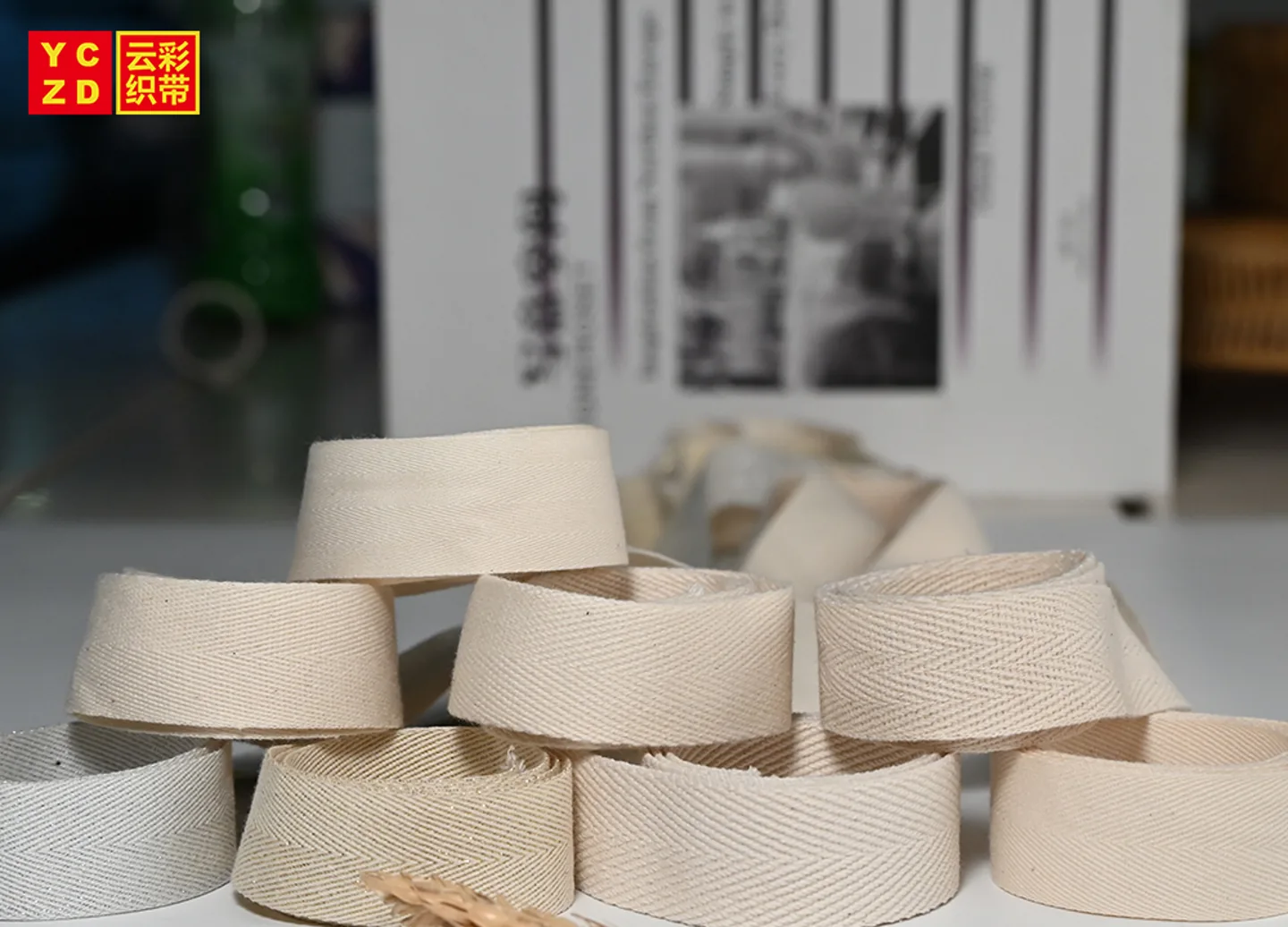
A photograph, tactile feel or colour cannot settle those decisions. An ecru shade may be achieved with several material routes; a slightly irregular surface may come from yarn, weave, finish or photography; and a clean, smooth tape may still contain recycled input. Treat supplier images as visual references only. Approve fibre declarations from documents and approve performance from identified physical samples and relevant test evidence.
This separation prevents two common sourcing errors. The first is accepting a natural-looking sample as proof of recycled cotton. The second is assuming that a verified recycled-content claim makes a tape suitable for the application. The buyer needs both answers, but they come from different evidence.
- Material claim: fibre names, percentages by mass and recycled-content basis.
- Construction: weave, yarn arrangement, edges, width, thickness and finish.
- Visual approval: colour, pattern, surface and acceptable variation.
- Application approval: sewing, folding, hardware contact, care and product-specific checks.
02Define What “Recycled” Means Before Requesting a Percentage
Textile Exchange distinguishes pre-consumer material diverted from the waste stream during manufacturing from post-consumer material generated after a product can no longer be used for its intended purpose. Rework or scrap that can be reclaimed within the same process is excluded from the pre-consumer definition used by its standards. Ask which source category is being claimed and how it is recorded; do not substitute the looser expressions “production waste,” “deadstock” or “sustainable cotton” for a defined input.
Also separate recycled content from recyclability, organic status and general environmental language. A tape can contain recycled cotton without being proven recyclable in its finished assembly. Recycled cotton is not automatically organic cotton, and neither term establishes a complete environmental comparison. The U.S. Federal Trade Commission advises marketers to qualify partial recycled-content claims and avoid broad, unsubstantiated “green” or “eco-friendly” claims. Destination-market rules and brand policies may require different wording or evidence.
Write the claim at component level. If the webbing is a blend, identify each fibre and state whether the recycled percentage applies to the entire webbing, the cotton portion or a particular yarn. Where warp, weft, binder, decorative yarn or another part uses a different material, map that construction rather than relying on one ambiguous percentage. The final public claim should be reviewed against the substantiated product data and the rules in the market where it will appear.
| Question | Weak answer | Buyer-ready answer |
|---|---|---|
| What is recycled? | The tape is eco-friendly | Named fibre, claimed recycled percentage and basis by mass |
| Where did the input come from? | Factory waste | Defined pre-consumer or post-consumer category with supporting records |
| What is the remainder? | Cotton blend | All constituent fibres and their declared percentages |
| What does the claim cover? | This style | Exact item, colour or lot, seller and transaction identified |
The wording used on a label or product page must not be broader than the evidence for the actual component.
03Choose the Evidence Route: Supplier Declaration, RCS or GRS
A buyer may receive a supplier declaration, laboratory composition result, certification documents or a combination. These tools answer different questions. ISO 1833-1 sets general principles for quantitative chemical analysis of fibre mixtures and points to method-specific parts of the series. Such testing may help quantify distinguishable fibre categories in a sample, but a composition result alone does not establish that cotton is recycled or trace its source through the supply chain.
Textile Exchange states that the Recycled Claim Standard and Global Recycled Standard provide third-party certification of recycled materials and chain of custody. RCS focuses on recycled input and traceability. GRS adds processing-related social, environmental and chemical requirements. The current standards also state important limits: RCS does not address quality or legal compliance, while GRS does not replace legal requirements and does not itself approve product quality. Select the route from the claim and customer programme, not from the assumption that one logo proves every attribute.
Request the document set required for the exact sale. A scope certificate indicates that an organisation is certified for stated activities and product categories during a stated period. It is not, by itself, shipment-level proof for every product the organisation offers. Textile Exchange chain-of-custody systems use transaction certificates to verify certified products moving between organisations. Confirm names, sites, standard, product description, material details, seller, buyer, dates, quantities and certificate status against the purchase being reviewed.
- Supplier declaration: useful only when the item, lot, basis, signatory and supporting records are clear.
- Composition analysis: may support fibre percentages within the method’s scope, but not recycled origin by itself.
- Scope certificate: confirms certified organisational scope, not every offered item or shipment.
- Transaction evidence: connects claimed certified material to a specific business-to-business movement.
- Public marketing claim: requires separate approval under the applicable claims policy and market rules.
04Review Recycled-Cotton Yarn and Webbing Construction Together
Mechanically recycled cotton is commonly produced by opening or shredding suitable textile waste before it is prepared for spinning. The 2025 Textile Exchange Guide to Recycled Materials identifies technical limits and additional due-diligence zones for mechanically recycled cotton yarn based on factors such as feedstock, fibre length, spinning route, yarn count and blend. Those requirements exist because an implausible yarn claim is a traceability risk, not because every recycled-cotton yarn will look or behave the same.
For a webbing buyer, the practical lesson is to request an achievable yarn-and-construction proposal instead of prescribing a recycled percentage in isolation. Increasing recycled input may change the available yarn route or require blending, but the effect on an actual tape depends on the full design. Ask the supplier to state the proposed fibre breakdown, yarn type where relevant, weave, density or internal construction code, finished width, thickness, mass reference, edges and finish. Keep unverified technical detail out of customer-facing claims.
Evaluate colour and surface deliberately. Recycled feedstock and blend choices may influence shade direction, specks, hairiness or lot variation, while dyeing and finishing can alter the result again. None of these features should be promised or rejected as inherent without production evidence. Define whether the target is a controlled solid shade, an intentionally natural appearance or a matched reference, and agree how much visible variation is acceptable using identified samples.
| Construction decision | Record before sampling | Risk if left open |
|---|---|---|
| Fibre system | Every fibre, recycled share, source category and evidence route | Ambiguous or overstated content claim |
| Yarn and weave | Supplier construction code plus buyer-visible requirements | Unexpected hand, surface or variation |
| Finished dimensions | Width, thickness or mass method and agreed range | Poor folder, seam or hardware fit |
| Colour and finish | Reference, lighting, face and approval condition | Shade dispute or misleading visual expectation |
| Edges and ends | Long-edge structure, cut method and exposed/end-enclosed state | Fraying, bulk, discomfort or assembly delay |
Do not copy a construction or tolerance from another tape. Build the specification around the intended product and feasible production route.
05Validate Production Fit With the Real Assembly and Care Route
Certification evidence and fibre declarations should travel with a separate performance plan. Start with the tape’s role. A decorative garment loop, a seam binding and a bag strap do not share the same loading, abrasion, folding, skin-contact, hardware or care conditions. Mark the exact webbing location on the drawing and identify adjacent fabrics, coatings, foams, threads, buckles and other materials that may affect the result.
Approve a production-intent tape, then sew, fold or route it through the actual assembly. Observe feeding, edge stability, needle response, puckering, folded thickness, slippage through hardware, contact feel and visible surface. Select dimensional, tensile, abrasion, colourfastness, laundering or other tests only where they answer a defined risk and the method applies to the specimen. Set acceptance criteria with the responsible brand, product engineer or test laboratory; no recycled-content standard supplies a universal performance grade for webbing.
Care exposure deserves particular attention when cotton-containing tape is combined with a different shell, lining or thread. Review dimensional change, shade, appearance, seam flatness and hardware fit after the intended cleaning route. A passing result on an unassembled strip cannot automatically release the finished product, and one colour or lot should not silently represent every variant if the materials or processing differ.
- Flat tape: composition record, dimensions, colour, surface, hand, edges and finish.
- Representative assembly: sewing, folding, hardware path, visible face and contact points.
- Relevant exposure: intended care, rubbing, flexing, abrasion or loading conditions.
- Decision record: sample code, method, result, acceptance status, reviewer and date.
06Approve the Sample and the Claim Documents as Two Linked Gates
Use two approval gates before production. The material-claim gate checks the declared composition, recycled-input basis, standard and certificate route, supplier identity, transaction evidence and permitted claim wording. The product gate checks the identified physical sample, construction, dimensions, shade, finish, assembly and performance evidence. Both gates should point to the same item code and revision so that an approved sample cannot be paired with unrelated paperwork.
Keep status language exact. “Supplier is in certificate scope,” “sample composition tested,” “transaction certificate received” and “finished assembly approved” are different states. Record the person responsible for each decision and any evidence still pending. If documents will only be issued after shipment, define what must be verified before purchase, what must appear before release and what happens if the promised transaction evidence does not arrive or does not match.
For repeat orders, control changes to feedstock category, recycled percentage, blend, yarn source, construction, production site, colour route and finish. The product name may stay the same while one of these inputs changes. Require written notification, decide which evidence must be refreshed and retain a new production reference when the change could affect the claim or application result.
07Recycled Cotton Webbing RFQ and Approval Checklist
A useful RFQ starts with the finished product, tape location and destination market. State the target fibre composition and recycled percentage, whether pre-consumer or post-consumer input must be distinguished, the required certification or declaration route and the wording the brand intends to use. Then specify the webbing construction, dimensions, colour, hand, edges, cut ends, supply format, assembly and validation plan.
Ask every quotation to repeat the proposed material breakdown and document route. Mark unknowns as “supplier recommendation requested” rather than allowing silent assumptions. Compare offers on the same basis: a lower price or faster sample that excludes transaction evidence, uses a different blend or changes the testing responsibility is not the same offer.
Before order release, connect the quotation, approved sample, bill of materials, certificate checks, purchase order and inspection plan with one item code and revision. This turns “recycled cotton” from a visual preference into a verifiable sourcing requirement while leaving room for the supplier to propose a feasible construction for the actual application.
- Finished product, tape location, destination market and intended public claim.
- Full fibre composition, recycled percentage basis and pre-/post-consumer requirement.
- RCS, GRS, declaration, test or other evidence route for the exact transaction.
- Webbing construction, width, thickness or mass reference, colour, hand, edges and finish.
- Seam, fold, hardware path, care route and application-based acceptance plan.
- Sample stages, document gates, item code, revision and responsible approvers.
- Quantity by variant, packing, change notification and repeat-order evidence refresh.
08Frequently Asked Questions
Can recycled cotton webbing be identified by colour or texture?
No. A cream colour, speckled appearance or soft surface may be a visual design choice, but it does not prove fibre identity or recycled origin. Verify the declared composition and recycled-content evidence, then approve the visible result on an identified physical sample.
Does a GRS or RCS scope certificate prove a specific webbing order is certified?
Not by itself. A scope certificate identifies an organisation’s certified scope. Buyers should also verify that the exact product and transaction follow the applicable chain-of-custody requirements and obtain the required transaction evidence from the seller or certification body.
Is recycled cotton the same as organic cotton?
No. “Recycled” concerns reclaimed material processed into new material, while “organic” concerns a different production and certification attribute. A blend may contain one, both or neither, but each claim needs its own accurate definition and evidence.
Is a higher recycled-cotton percentage always better for webbing?
There is no universal product answer. The target percentage must be feasible for the yarn and webbing construction and still meet the finished product’s appearance, sewing, care and performance needs. Compare production-intent options and substantiate any environmental claim separately.
What should buyers test on recycled cotton webbing?
Choose checks from the application risks. Common review areas can include composition, width, thickness or mass, shade, surface, dimensional change, rubbing, abrasion, tensile behaviour, seam performance and hardware fit. Use named methods only when their scope fits the specimen, and validate the complete assembly where relevant.
09Continue From Guide to Specification
Compare the relevant product family and application page before sending your RFQ.
10Sources & further reading
Sources support the principles discussed; the final specification and test plan must follow the application and buyer requirements.
- Recycled Claim Standard 3.0Textile Exchange
- Global Recycled Standard 5.0Textile Exchange
- Guide to Recycled Materials, Version 2.0Textile Exchange
- Content Claim StandardTextile Exchange
- Environmental Claims: Summary of the Green GuidesU.S. Federal Trade Commission
- ISO 1833-1:2020 — Quantitative Chemical Analysis of Fibre MixturesInternational Organization for Standardization