
01Start With What STANDARD 100 Does—and Does Not—Prove
OEKO-TEX STANDARD 100 is a product certification for textiles and accessories tested for harmful substances. The official 2026 standard applies across production stages, from fibres and yarns to fabrics, accessories and finished articles. For a webbing buyer, that means a narrow textile component can be certified in its own right when it is included in an issued certificate scope. It also means the buyer must identify which article or component the certificate actually covers rather than treating the logo as a general factory rating.
The standard itself draws an important boundary: STANDARD 100 is not a general quality label. It does not state whether a webbing has the required breaking force, abrasion resistance, stretch recovery, colourfastness, shrinkage, flame behaviour, hardware fit or service life. Those properties need separate specifications and evidence. It also does not replace the legal and product-safety work required for a finished garment, bag, shoe or child-related product.
This distinction makes the certificate more useful, not less. Use it to answer a defined harmful-substance certification question for a defined textile article. Use engineering tests, buyer restricted-substance requirements, product regulations and assembly validation to answer the other questions. Combining these evidence types in one order file avoids both under-checking and overclaiming.
| Buyer question | Can STANDARD 100 address it? | What else may be needed |
|---|---|---|
| Is this identified textile article certified for harmful substances? | Yes, when the live certificate and written scope cover it | Item-level mapping to materials, colours, processes and components |
| Will the webbing meet a load, abrasion or recovery requirement? | No | Named physical test, approved limit and application validation |
| Does the certificate prove recycled or organic content? | No, not by itself | The applicable content and chain-of-custody programme and documents |
| Is the finished garment, bag or shoe certified? | Only if the complete finished article is within an applicable certificate scope | Finished-product certificate or accurately limited component claim |
Keep each claim attached to the evidence system that actually answers it.
02Run the Official Label Check Before Reading Marketing Copy
Start with the official OEKO-TEX Label Check, not a supplier screenshot or copied logo. Enter the certificate number exactly as printed; the official tool states that label numbers are case-sensitive. If the result does not appear, recheck punctuation and spacing, then contact OEKO-TEX or the issuing institute rather than assuming that an old PDF remains current.
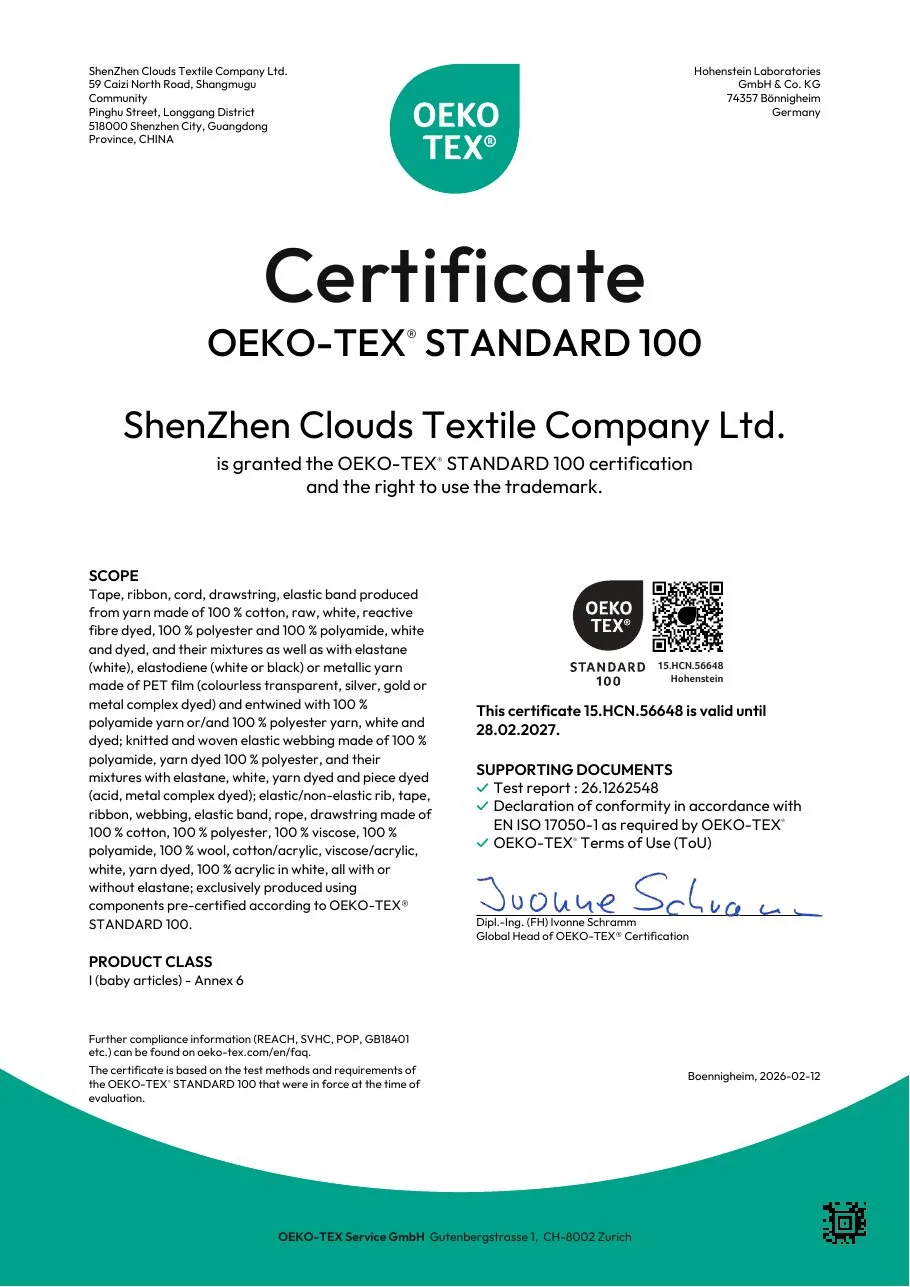
Compare the live result with the PDF line by line. Record the status, certificate owner, address, standard, Annex, product class and full type-of-certified-article wording. The live check for YCZD certificate 15.HCN.56648 on 8 September 2026 returned “The certificate is valid,” identified ShenZhen Clouds Textile Company Ltd. as the owner, stated certification according to Annex 6 and showed Product Class I together with a detailed scope for specified tapes, ribbons, cords, drawstrings, elastic bands, elastic webbing and rib articles.
A valid status is the first gate, not the final approval. The result confirms that OEKO-TEX recognises the certificate and displays its current scope; it does not tell the buyer that a particular SKU, colour, finish or shipment matches that scope. Save the check date or a controlled record and continue with an item-level comparison.
- Use the official Label Check and enter the number exactly, including punctuation and letter case.
- Match the owner and site to the party supplying or producing the relevant article.
- Record the displayed standard, Annex, product class and complete product description.
- Check again near order approval or shipment if the certificate may expire or change during the programme.
03Decode Product Class and Annex Without Expanding the Claim
STANDARD 100 uses four product classes based on intended use and skin contact. Product Class I covers articles, materials and accessories intended for babies and children up to 36 months and carries the strictest requirements. Product Class II addresses products with direct skin contact, Product Class III those without direct skin contact, and Product Class IV decoration materials. A higher-sensitivity class can support use in less intensive contact contexts, but the certified article must still match the written scope.
Annex 4 and Annex 6 are criteria catalogues, not quality grades for strength or workmanship. The 2026 standard describes Annex 6 as expanded requirements that add further and often stricter parameters intended to support improved environmental performance during production. The certificate or live result identifies which Annex applies. Do not rewrite “Annex 6” as a broad sustainability certification or as evidence of socially responsible manufacturing; OEKO-TEX points to separate production-site systems for wider environmental and social assessment.
For sourcing, copy the product class and Annex exactly into the documentation review. Then ask whether the buyer actually requires that class and whether the proposed item uses the covered materials and process states. Do not infer certification merely because the class sounds suitable for the end use.
| Certificate field | What it tells the buyer | Common overreach to avoid |
|---|---|---|
| Product Class I | The certified scope meets the class used for babies and children up to 36 months | Claiming every baby product made by the holder is certified |
| Product Class II or III | The intended skin-contact category applied during certification | Treating the class as a durability or comfort rating |
| Annex 4 | The applicable human-ecology criteria catalogue | Calling it a complete product-safety approval |
| Annex 6 | Expanded requirements beyond Annex 4 for specified parameters | Calling it a full environmental or social certification |
Product class and Annex qualify the certified scope; they do not replace the scope wording.
04Map Every Ordered Variation to the Written Certificate Scope
The 2026 standard explains that certificate scope is a product description used to identify certified articles and components. It can include product category, fibre composition, processed state, dyestuff class, printing technique, special colours, finishes and accessories. Those fields create a practical checklist for the buyer. If the order differs in any material way, request written confirmation before using the certificate as evidence.
Begin with product form and construction: webbing, tape, ribbon, elastic band, knitted elastic webbing, woven elastic webbing, cord, drawstring or rib are not interchangeable descriptions. Next compare each fibre and blend, including elastane or elastodiene where relevant. Then compare the state and process: raw, white, dyed, yarn dyed, piece dyed, printed, coated, metallic or finished. A certificate may cover some of these routes and exclude others.
Colours and components deserve their own review. Dark shades, metallic yarns, prints, coatings, silicone applications, transfer decorations, sewing threads, tips, labels, buckles and other additions can change the applicable scope. A phrase requiring articles to be made exclusively from pre-certified components is a condition, not decorative wording. Obtain the supplier’s item-level scope statement or test-institute clarification when the mapping is not obvious.
| Order field | Evidence to compare | Escalate when |
|---|---|---|
| Article type | Exact product category and construction wording | The order uses a form not named or clearly included |
| Composition | Each fibre, blend and elastic component | A new fibre, recycled input or unlisted blend is proposed |
| Colour and process | Raw, white, dyed, yarn-dyed, printed, coated, metallic and finish wording | A new dye class, print, coating or finish is added |
| Components | Condition for pre-certified inputs and any listed accessories | An outside tip, label, thread, buckle or chemical treatment is introduced |
A close commercial description is not enough when the certificate wording does not clearly include the proposed variation.
05Separate Component Certification From Finished-Product Claims
A webbing certificate can support a component-level statement when the exact webbing is within scope. It does not automatically certify the garment, backpack or shoe that incorporates it. OEKO-TEX guidance warns against “ingredient labelling”: if a complete T-shirt is presented as STANDARD 100 certified, every relevant component of that finished article must be covered and tested, not only the main fabric. The same logic prevents a certified strap or elastic from being used to imply certification of an entire assembled product.
Write the claim at the level of the evidence. “The proposed webbing is within certificate number X, subject to confirmation of the listed construction, material and process” is an item-level procurement statement. “The finished bag is OEKO-TEX certified” is a finished-product claim and requires evidence for that finished bag. Marketing use of the label must follow the current OEKO-TEX Labelling Guide and licence conditions; buyers should not create their own logo treatment or remove the traceability information.
Also separate STANDARD 100 from other programmes. It is not MADE IN GREEN, STeP, ECO PASSPORT, GRS, GOTS or an ISO management-system certificate. Each system has a different object, scope and evidence chain. Asking “which exact programme supports this exact claim?” is a reliable way to prevent a familiar logo from doing work it was never designed to do.
06Control Changes, Renewal and Repeat Orders
OEKO-TEX states that STANDARD 100 certificates are issued for one year. The 2026 standard also requires the holder to notify the institute about changes to materials, blends, technical procedures or recipes. Professionally altered or treated certified goods may lose the right to be represented as certified until the institute confirms coverage. For buyers, certificate verification therefore belongs in change control, not only in first-supplier approval.
Create a certificate-review trigger for new fibres, yarn suppliers, dyestuffs, colour families, prints, coatings, finishes, metallic effects and outside components. Repeat the mapping when an approved item changes site, construction or process. Keep the last approved sample and item revision connected to the certificate version or live-check record used for approval. If an order spans the expiry date, agree what renewed evidence must be available before production or shipment.
Do not treat a renewed certificate number as proof that nothing changed. The official standard notes that a certificate number can remain the same after seamless renewal. Compare the new validity, owner, site, product class, Annex and scope, and ask whether the proposed item or its process changed. The useful control is continuity of the article-to-scope match, not continuity of the number alone.
- Record certificate number, check date, validity and the saved source used for the decision.
- Link the covered item code, construction, composition, colour family, process and approved sample revision.
- Require notice before material, recipe, supplier, finish, site or outside-component changes.
- Recheck the live record before relying on a renewal or an order that crosses the expiry date.
07Use a Five-Gate Certificate Review for RFQs and Orders
A short review matrix is more useful than collecting a folder of unlabeled PDFs. Gate one is authenticity: the official Label Check returns a valid record. Gate two is identity: holder, site and issuing institute match the certificate and supply route. Gate three is scope: product form, composition, colour, process, Annex and product class cover the proposed item. Gate four is claim: internal and customer-facing language stays at the same level as the evidence. Gate five is continuity: expiry, changes and repeat-order controls are defined.
Record unresolved points as questions, not assumptions. Ask the supplier to identify the exact scope phrase that covers the item and to confirm any new material or treatment with the issuing institute. For higher-risk or regulated products, connect the certificate review to the buyer’s restricted-substance list, legal review, physical-performance plan and finished-product testing. STANDARD 100 can be one strong part of that file without being asked to replace every other control.
For YCZD documentation, buyers can open the unchanged original certificate PDF from the quality-documentation page and independently check the public certificate number. The current public record is useful evidence for the listed narrow-textile scope. Final order approval still depends on matching the proposed article and variations to that exact wording and agreeing any additional market or customer requirements.
| Review gate | Pass evidence | If unclear |
|---|---|---|
| 1. Authenticity | Official Label Check returns a valid record | Re-enter the exact number or contact the institute |
| 2. Identity | Holder, site and certificate details align | Clarify the manufacturing and supply route |
| 3. Scope | Article, composition, process, class and Annex match | Request item-level or institute confirmation |
| 4. Claim | Wording describes only what is certified | Remove whole-product or unrelated performance claims |
| 5. Continuity | Expiry and change controls cover the order | Hold reliance until renewed or revised evidence is available |
Approve the evidence-to-item match, not the presence of a logo.
08Frequently Asked Questions
How do I verify an OEKO-TEX STANDARD 100 certificate number?
Enter the exact, case-sensitive number in the official OEKO-TEX Label Check. Compare the live status, owner, site, product class, Annex and complete certified-article description with the PDF and the item being purchased.
Does an OEKO-TEX-certified yarn make finished webbing certified?
Not automatically. Pre-certified inputs may be considered during certification, but the finished webbing must be within an applicable certificate scope and comply with any scope conditions. Ask for the certificate that covers the ordered article, not only an upstream yarn certificate.
Does Product Class I mean every product from the supplier is safe for babies?
No. Product Class I applies to the articles, materials and accessories within the issued scope. The proposed item must match that scope, and the finished baby product may still require separate legal, design, mechanical and finished-product safety work.
Does OEKO-TEX STANDARD 100 prove webbing strength or durability?
No. The official standard states that the mark is not a general quality label and does not cover fitness for use or other performance properties. Use named physical tests and application-specific acceptance limits for strength, abrasion, recovery, shrinkage and hardware or seam performance.
When should a buyer recheck the certificate?
Check it during supplier and item approval, before relying on a renewal, when an order approaches or crosses expiry, and whenever materials, colours, recipes, processes, sites or components change. Keep the check date and item-level scope mapping in the order file.
09Continue From Guide to Specification
Compare the relevant product family and application page before sending your RFQ.
10Sources & further reading
Sources support the principles discussed; the final specification and test plan must follow the application and buyer requirements.
- OEKO-TEX STANDARD 100 — Official Overview and Product ClassesOEKO-TEX
- OEKO-TEX STANDARD 100 — Standard, Edition 01.2026OEKO-TEX
- OEKO-TEX Label CheckOEKO-TEX
- Label Check Detail — Certificate 15.HCN.56648OEKO-TEX
- Labelling and GreenwashingOEKO-TEX
- OEKO-TEX STANDARD 100 — Declaration of Conformity, Edition 01.2026OEKO-TEX