
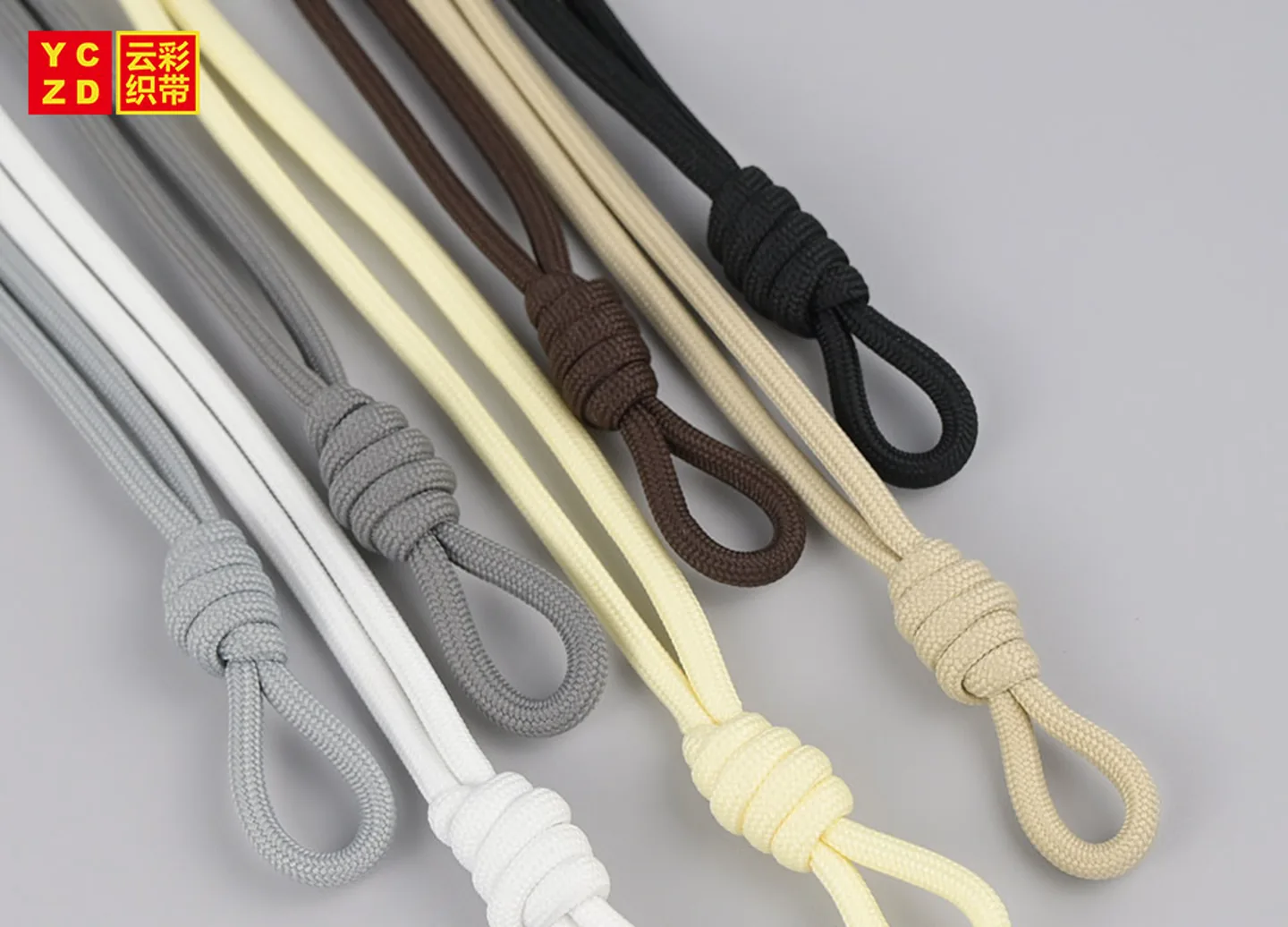
01Define the Cord as a Construction, Not a Colour and Diameter
A sourcing request such as “5 mm black cord” leaves the most important product decisions open. The cord may be braided, twisted or built as a core-and-cover structure. It may be solid or hollow, round or intentionally flattened, soft or firm, elastic or relatively stable. The surface may be smooth, visibly ribbed, glossy, matte or deliberately spiral. Each choice changes how the cord bends, compresses, moves through hardware, accepts an end treatment and looks in the finished product.
Start with the product and the cord path. Mark whether the component is a hood or waist drawcord, shoe-lacing element, heel loop, bag closure, decorative loop, handle detail or another part. Show every eyelet, channel, cord lock, knot, fold, stitch and tip. Record where users grip it, where it rubs another material and whether it is tensioned in normal use. A construction that works as a loose sample can flatten, twist, snag or become bulky once routed through the real assembly.
Use construction names carefully. ISO 1968 supplies vocabulary for fibre ropes and cordage, but a trade description alone is not a complete apparel or accessory specification. Ask the supplier to declare the proposed build in project language: braid or twist, number or arrangement of strands when relevant, core and cover, yarn type, elastic element, surface treatment and intended face or direction. Tie that declaration to an identified physical sample and revision.
- Identify the finished product, component function and complete cord path.
- State braided, twisted or core-and-cover construction instead of only “round cord.”
- Describe visible surface, firmness, compression and stretch expectations.
- List hardware, knots, seams, loops and end treatments that touch the cord.
02Compare Braided, Twisted and Core-and-Cover Directions
A braided cord is formed by interlacing yarns or strands around a path. Depending on braid pattern, yarn, pick or pitch, core and finishing, the result can be round, flat, hollow, dense, soft or expandable. Buyers often shortlist braided construction when they need a balanced-looking surface, flexibility around curves or a cover that contains a core. Braided does not automatically mean stronger, smoother or more abrasion resistant; those outcomes belong to the exact build and test condition.
A twisted or laid cord is formed by twisting elements together, creating a visible helical direction. The construction can support a pronounced spiral appearance and a hand that suits decorative or traditional details. Twist direction, number of elements, twist level, yarn and finish influence torque, opening, fraying and shape. A twisted cord is not inherently weaker or less stable than a braid, and a catalogue photograph cannot establish how it will behave after cutting or laundering.
Core-and-cover language adds another layer. A braided cover may surround a parallel, twisted, braided or elastic core, while some cords are built without a separate core. The cover controls much of the visible surface and contact with hardware; the core may affect body, stretch or force. Do not infer the core from the exterior. Require a construction declaration or controlled sample section when the internal build matters, and make sure any cut section is treated safely and does not become an unsupported production claim.
| Construction direction | Useful reason to shortlist it | What the sample must confirm |
|---|---|---|
| Braided | Interlaced surface, flexible routing or a controlled cover around a core | Roundness, compression, snagging, bending, surface and end security |
| Twisted or laid | Visible spiral, decorative hand or a specified strand arrangement | Torque, opening, fraying, shape retention and cut-end behaviour |
| Core and cover | Separate visible surface from internal body or stretch function | Core identity, cover movement, slippage, exposure and tip compatibility |
| Hollow or solid direction | Compression, low bulk, insertion or a particular hand | Flattening, recovery, stitching, knot bulk and hardware passage |
These are development directions rather than universal rankings. The exact yarn, geometry and finish determine the delivered result.
03Control Diameter, Linear Density, Lay and Braid Pitch
Nominal diameter is not enough when a cord is soft or compressible. State whether the value is a target, range or reference and define how the specimen is relaxed, conditioned, tensioned and contacted during measurement. A calliper can compress a soft braid; a twisted cord may show high and low points; an elastic core can change diameter under extension. Agree the method before using a tight tolerance, and record both the measured condition and the instrument where they affect the result.
ISO 2307 publicly identifies diameter, linear density, lay length, braid pitch, elongation and breaking force as measurable rope characteristics. That scope is useful for understanding why construction needs more than one number, but the standard is written for fibre ropes. Do not cite it automatically as the acceptance method for a fashion drawcord. Decide with the laboratory whether a rope method, textile method, buyer method or controlled comparative procedure fits the component and intended decision.
Linear density or mass per unit length can help distinguish two cords that share a nominal diameter but contain different amounts or arrangements of material. Lay length and braid pitch describe repeating construction geometry and can help protect surface appearance, firmness and repeatability. Record the chosen fields on the sample card, along with measurement direction, specimen state and units. Never reverse-engineer fibre content or performance from mass and appearance alone.
| Geometry field | Why buyers record it | Condition that must travel with the value |
|---|---|---|
| Finished diameter or width | Controls channels, eyelets, cord locks, visual scale and grip | Relaxation, conditioning, tension, contact pressure and measurement locations |
| Linear density | Adds a material-quantity check when diameter alone is ambiguous | Specimen length, conditioning, units and inclusion of tips or joins |
| Braid pitch or lay length | Controls visible repeat and supports construction comparison | Reference tension, direction, measurement span and averaging rule |
| Shape under load | Shows narrowing, flattening or rotation during use | Named load or extension, dwell time and recovery interval |
04Validate Hardware, Knots, Loops and End Treatments Together
Cord and hardware form one system. Send the production eyelet, channel, stopper, bead, toggle, aglet or moulded tip with the sample request. Check insertion, travel, holding, release, surface marking and noise where relevant. A soft braid may compress through a small opening yet slip in a cord lock; a firm cord may hold well but jam at a bend. Twisted elements can rotate against hardware or open when an end is cut. These outcomes need an assembly trial, not a construction stereotype.
End treatment must fit the construction and the intended appearance. Options may include a knot, wrapped end, stitched fold, heat-controlled finish, crimp, adhesive, moulded part or separate tip, but availability and compatibility must be confirmed for the actual cord. Review bulk, sharpness, exposure of internal elements, pull-off risk, colour change and wash response. Do not assume that a method used on one fibre or diameter transfers unchanged to another.
Loops and sewn attachments introduce bend radius, compression and load concentration. Build a production-intent trial with the actual cord, fabric, reinforcement, thread, stitch and hardware. Inspect whether the cord rotates, flattens, migrates, damages the surrounding material or creates uncomfortable bulk. For footwear and bags, verify repeated user handling and the full attachment path. For children’s garments or any regulated use, apply the specific product-safety requirements before optimizing appearance.
- Test the production-equivalent eyelet, channel, lock, tip and attachment.
- Record insertion and movement as well as holding or pull behaviour.
- Inspect the cut end and internal structure before approving the finish.
- Approve knots, loops and sewn anchors on the actual assembly geometry.
05Specify Surface, Colour and Care on the Actual Construction
Braiding and twisting expose yarns to light and contact in different directions. The same nominal colour can appear different on a compact braid, an open braid and a spiral twisted surface. Approve colour on the final construction rather than on loose yarn alone. State the physical or coded reference, lighting and acceptable relationship to the garment, bag or shoe materials. When several colours or reflective elements are combined, specify placement, repeat and viewing orientation.
Surface contact deserves its own review. Run the cord through the channel and hardware, rub it against adjacent light and dark materials and inspect both the cord and contact surface. ISO 105-X12 covers dry and wet rubbing colourfastness for textile materials, but the buyer still needs application-specific acceptance criteria and may need an assembly exposure that the standard test does not reproduce. Do not turn one colourfastness result into a universal claim about abrasion, pilling or service life.
Care and finishing can change hand, dimensions, torque, cover movement and end security. ISO 6330 provides defined domestic washing and drying procedures for textile testing; select only the route that matches the intended care claim and product. Evaluate a loose cord and representative assembly when both decisions matter. Record whether the sample was washed, dried, pressed, garment-dyed or otherwise treated before comparison, because untreated and post-process cords are not the same approval state.
| Review area | Loose-cord check | Finished-assembly check |
|---|---|---|
| Colour and appearance | Shade, lustre, spiral or braid repeat and face | Relationship to fabric, leather, hardware and normal viewing angle |
| Surface contact | Snags, loose filaments and dry/wet transfer | Movement through channels and marking of adjacent materials |
| Care response | Diameter, length, torque, hand and end security | Puckering, migration, hardware function and overall appearance |
| Post-process state | Effect of heat, dyeing, washing or finishing | Compatibility with the complete production sequence |
06Choose Test Methods That Match the Component and Decision
A construction comparison should not begin with a borrowed breaking-force number. First identify the failure that matters: excessive stretch, poor recovery, opening of strands, tip detachment, colour transfer, surface damage, hardware slippage, seam failure or another assembly issue. Select a method for each decision and state specimen, conditioning, direction, machine, clamps, speed, cycles, endpoint, units and acceptance rule. Keep visual criteria tied to identified reference samples.
ASTM D6775 covers breaking strength and elongation of textile webbing, tape and braided materials using a specified clamp type and within its published scope. It can be relevant to a braided component when the product and laboratory confirm applicability. It is not automatically the right method for every twisted cord, elastic drawcord, tiny finished loop or complete shoe. ISO 2307 addresses rope characteristics under a different framework. Results from unlike methods or specimen states should not be treated as interchangeable.
Component data do not rate the finished product. A cord can meet an agreed material test while the eyelet pulls out, a seam tears, a lock slips or a tip detaches. Validate the assembly and finished item under the applicable brand protocol, market rule and foreseeable use. General apparel and accessory cords must never be promoted for climbing, fall arrest, lifting, restraint or other life-safety use without product-specific engineering, applicable standards and verified certification.
- Name the method and current edition; do not write only “tensile test.”
- Keep specimen form, conditioning, clamps and settings comparable.
- Report component, attachment and finished-product results separately.
- Investigate method or laboratory bias before changing an approved limit.
- Exclude life-safety claims unless the complete product is designed and verified for them.
07Use a Cord Construction Decision Matrix and RFQ Checklist
Shortlist braided construction when interlaced appearance, flexible routing, controlled cover or core options fit the design. Shortlist twisted construction when spiral character, strand visibility or a particular decorative hand is important. Then compare production-intent samples rather than generic category names. Score geometry, surface, compression, torque, hardware movement, end treatment, assembly, care and required test evidence. Weight the failure risks that matter to the product.
A useful RFQ includes the product and cord location, target market, construction direction, declared yarn or acceptable options, core, finished diameter or width, colour, surface, stretch, cut length, hardware, end treatment, attachment, care route, tests, packaging and quantity by variant. Mark unknown fields as open for a documented proposal. Ask each supplier to repeat assumptions and deviations so quotations describe comparable products instead of visually similar cords built to different baselines.
Approve one identified sample and specification together. Record item code, colour, revision, construction declaration, dimensions and methods, physical reference, hardware, tip, seam, care result and authorised decision. Keep any later material, core, braid, twist, finish, diameter, hardware or end-treatment change behind a new review gate. This turns “same cord as before” into a traceable product configuration that design, sourcing, quality and production can all understand.
| Decision gate | Evidence to retain | Release question |
|---|---|---|
| Construction shortlist | Braided or twisted direction, yarn, core, geometry and risk priorities | Does the proposed build suit the real cord path? |
| Development sample | Identified physical sample, measurements and surface review | Is the cord itself reproducible and acceptable? |
| Assembly trial | Hardware, end treatment, seam, care and user interaction | Does the component work in the actual product? |
| Production baseline | Signed revision, methods, limits, packing and change notice | Can the approved configuration be repeated and verified? |
08Frequently Asked Questions
Is braided cord always stronger than twisted cord?
No. Strength depends on fibre, yarn, construction, amount of material, geometry, finish, specimen state and test method. Compare identified production-intent cords with one applicable method and product-specific limits rather than ranking construction names.
What is the difference between braid pitch and lay length?
Both describe repeating construction geometry, but braid pitch belongs to braided structures and lay length to twisted or laid structures. The measurement condition, reference tension, direction and averaging rule must be stated with the value.
How should a soft cord diameter be measured?
Agree how the cord is relaxed, conditioned, tensioned and contacted because soft cords compress and elastic cords change diameter under extension. Record the instrument, pressure or method and several representative locations instead of treating one calliper reading as self-explanatory.
Can one cord sample be approved without the cord lock or eyelet?
That is risky when hardware is part of the product. Diameter, compression, surface, torque and end treatment affect insertion, adjustment, holding and wear. Approve a production-intent cord with the actual or equivalent hardware and assembly path.
Does ASTM D6775 apply to every apparel drawcord?
No. Its scope covers breaking strength and elongation of textile webbing, tape and braided materials using a specified clamp system. The buyer, supplier and laboratory must confirm whether it fits the exact cord and decision; twisted, elastic, very small or finished assemblies may need another applicable method or a separate assembly test.
09Continue From Guide to Specification
Compare the relevant product family and application page before sending your RFQ.
10Sources & further reading
Sources support the principles discussed; the final specification and test plan must follow the application and buyer requirements.
- ISO 1968:2004 — Fibre Ropes and Cordage VocabularyInternational Organization for Standardization
- ISO 2307:2019 — Determination of Certain Physical and Mechanical Properties of Fibre RopesInternational Organization for Standardization
- ISO 9554:2019 — Fibre Ropes General SpecificationsInternational Organization for Standardization
- ASTM D6775-13(2024) — Breaking Strength and Elongation of Textile Webbing, Tape and Braided MaterialASTM International
- ISO 105-X12:2016 — Colour Fastness to RubbingInternational Organization for Standardization
- ISO 6330:2021 — Domestic Washing and Drying Procedures for Textile TestingInternational Organization for Standardization